From City of God to Slumdog Millionaire: Filming ‘underbelly’ of nations…

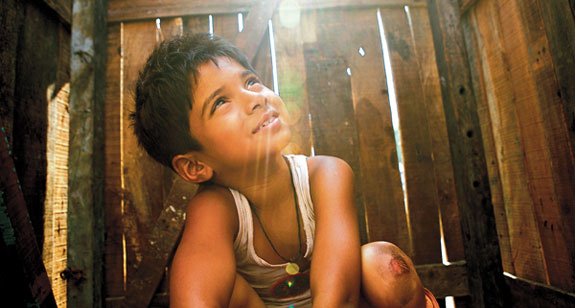
From 'Slumdog Millionaire'

“Can you help us to film a child’s leg being broken?”

In his long years of journalism in India, my friend Darryl D’Monte had faced all sorts of questions and situations. But this was one question that stunned and left him speechless for a while.

A visiting Canadian TV crew made this request in the 1970s, when Darryl was resident editor of The Times of
India
. He was giving them some insights on the extent of poverty in his city of Bombay, since renamed as Mumbai. The crew had heard of the deliberate maiming of street children, before being employed as beggars. A disabled child would evoke more sympathy, increasing the daily collection for gangsters operating them from behind the scenes.

Darryl wasn’t willing to be associated with this ‘staging’. “Well, it’s going to happen anyway,” was the film crew’s cynical answer.

Now, fast forward 30 years to the present. At one point in the British-Indian movie Slumdog Millionaire, we see a young girl being blinded by a gangster who shelters and feeds a small army of children — all unleashed on Mumbai on a daily basis to tug at the heart strings of its teeming millions.

The film’s protagonist Jamal escapes the same fate by making a mad dash for freedom with his brother, Salim. But years later, they cross the gangster’s path again, with devastating results – for him.

Look what I've started...
Vikas Swarup: Look what I've started...
Set and filmed in India, Slumdog Millionaire is the story of a young uneducated man from the slums of Mumbai who appears on the Indian TV’s version of Who Wants to Be a Millionaire? (Kaun Banega Crorepati) and does so well to reach the final question that the game show host and the police suspect him of cheating.

Some Indians feel their country’s ugly underbelly has been magnified by locating and filming part of the story in the slums of Mumbai. But director Danny Boyle, who sees his film as a Dickensian tale, says he shot in real, gritty locations “to show the beauty and ugliness and sheer unpredictability” of the city.

Indian diplomat Vikas Swarup, who wrote the 2005 novel Q and A on which the movie is based, has a similar view. “This isn’t social critique,” he told The Guardian in an interview. “It’s a novel written by someone who uses what he finds to tell a story. I don’t have firsthand experience of betting on cricket or rape or murder. I don’t know if it’s true that there are beggar masters who blind children to make them more effective when they beg on the streets. It may be an urban myth, but it’s useful to my story.”

To me, Slumdog Millionaire feels like a cross between the acclaimed Brazilian slum movie City of God (Portuguese name: Cidade de Deus, 2002) and Quiz Show, the 1994 American historical drama film about TV quiz scandals in the 1950s.
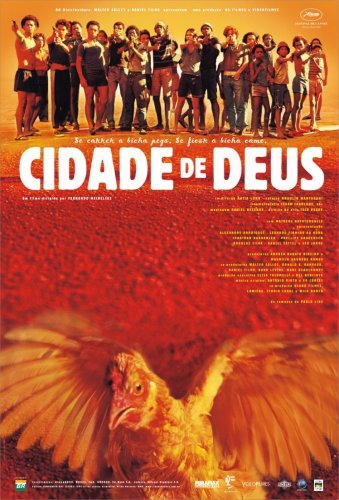
City of God (2002) was filmed in the favelas of Rio de Janeiro

City of God is a Brazilian crime drama film directed by Fernando Meirelles and Kátia Lund, released in its home country in 2002 and worldwide in 2003. It was adapted by Bráulio Mantovani from the 1997 novel of the same name written by Paulo Lins.

The film’s depiction of narcotic drug rings, hold-ups, street violence and police corruption may not have been what the upper middle class Brazilians wanted to showcase to the rest of the world, but the film’s stark if grisly authenticity resonated with movie audiences around the world. Most of the actors were residents of favelas (slums) of Rio de Janeiro, such as Vidigal and the Cidade de Deus itself. City of God became one of the highest-grossing foreign films released in the United States up to that time.

The makers of Slumdog Millionaire adopted a similar approach. Its co-director Loveleen Tandan says she likes to get as close to reality as possible. This drove her to the slums of East Bandra to look for young children who resembled the protagonists in the story.

As she recalled in a recent interview with Tehelka: “I was very keen to get real slum kids, which is why I convinced them (producers) to do one-third of the scenes in Hindi. I made a scratch tape with real street kids. The team was surprised that Hindi actually made it brighter and more alive.”

Indeed, Slumdog doesn’t feel like a ‘foreign film’ despite it having a fair number of English subtitles, which only enhance the overall cinematic experience.

But how realistic should films try to become, before the local realities are distorted or local sensibilities are affected? Where does documentary end and drama begin? These questions will continue to be debated across India and elsewhere while Slumdog enthralls millions on its first theatrical release.

Feature film makers can exercise their creative license far more than factual film makers. I doubt if the creators of authentic, close-to-the-ground movies like City of God and Slumdog Millionaire set out with any specific social agenda. They are in the business of entertainment, and just happen to find plenty of drama in real life in places like urban slums. We might argue that in the right hands, dramatised movies can draw mass attention to development issues and challenges far more effectively than the often dull and dreary documentaries.

Eyes wide open
Kalpana Sharma: Eyes wide open
“If through (the movie) the world gets a peek at an India inhabited by millions of people who continue to live their lives without clean water, sanitation or electricity, what is the problem?” asks another Indian friend and long-time Mumbai resident Kalpana Sharma.

In a perceptive essay titled Shantytowns of the Mind, written in The Indian Express in early January 2009 before she saw the film, Kalpana flagged important concerns: “Slumdog Millionaire’s success raises some deeper questions. How do we depict poverty as writers, filmmakers, journalists? Is it fair to expect us all the time to give a full, balanced, sensitive portrayal? Or is it inevitable that we write, film, for our audiences? And if, as a byproduct, people are sensitized, so be it. Also, if they are annoyed, so be it. If we are considered exploitative, so be it.”

Kalpana speaks with authority, and not just because she lives in the megacity of Mumbai (population: 13 million and rising) which, she points out, is half made up of slums. In 2000, she wrote a book titled Rediscovering Dharavi: Stories from Asia’s Largest Slum. Far from being a cold, clinical analysis of facts, figures and trends, it’s a book about the extraordinary people who live there, “many of whom have defied fate and an unhelpful State to prosper through a mix of backbreaking work, some luck and a great deal of ingenuity”.

Kalpana ends her essays with these words: “In the end you realise as a writer, a journalist or a filmmaker, that the best you can do is to shine a torch, a searchlight, on an entrenched problem. But the solution will not be found merely by that illumination. For that, there are many more steps to be taken.

Slumdog Millionaire has focused its lens on the children of India’s slums through a work of fiction. What we do to change their future is the non-fiction that has yet to be written.”

Read Shantytowns of the Mind by Kalpana Sharma, Indian Express, 14 January 2009

India rising...but not for all slumdogs?

Romulus Whitaker: Mixing films and conservation in India

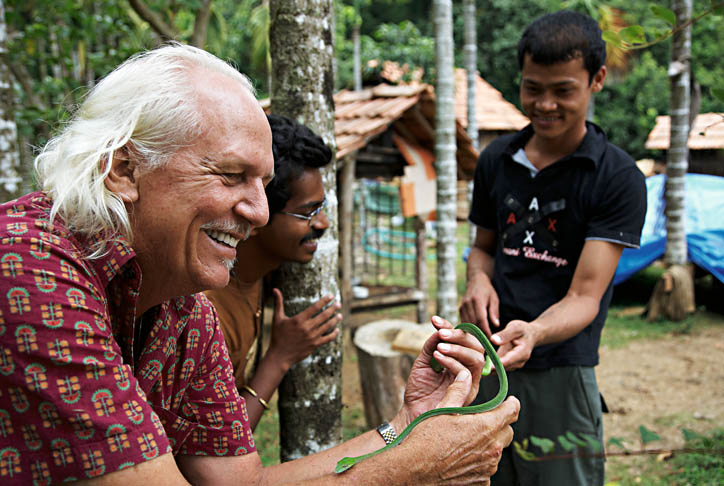
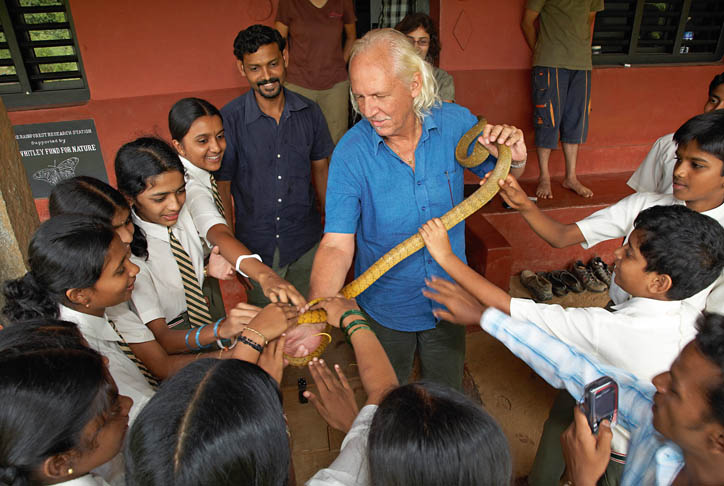
A young volunteer gets to know a snake at Agumbe research station - photo courtesy Rolex Awards
Romulus Whitaker introduces a young volunteer to a snake at Agumbe research station, Tamil Nadu, India – photo courtesy Rolex Awards

“I haven’t had to do a nine-to-five job ever in my life, and that is a very envious situation to be in if you like the wild. Life has been much like a river in that it picks you up and carries you along. I have got into things as they come towards me.”

That’s how Romulus Whitaker, reptile and amphibian specialist, conservationist and filmmaker sums up his long, eventful and illustrious career. At 65, he is full of zest for life, ready to take on new challenges in protecting India’s forests and wildlife.

His current ambition, for which he has just been selected as an Associate Laureate in the 2008 Rolex Awards for Enterprise, is to create a network of rainforest research stations throughout India.

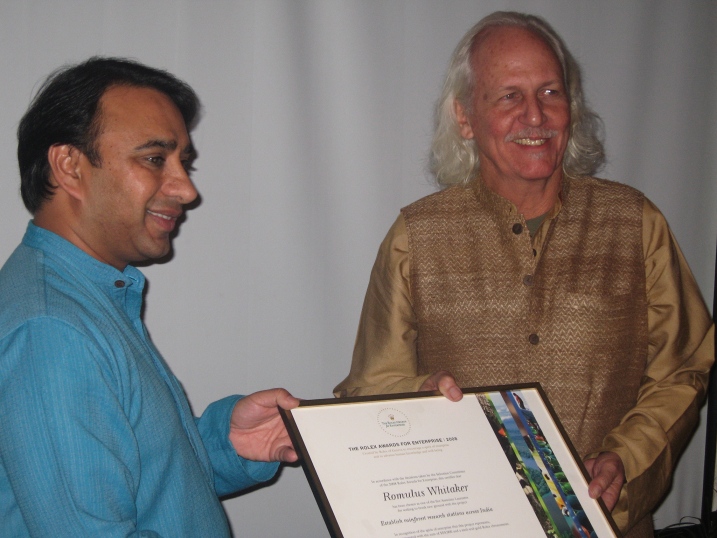
I caught up with this American-born, naturalised Indian citizen a few days ago when he and fellow Indian Moji Riba were presented with their Rolex awards at a ceremony in New Delhi.

Of course, I’d heard about Romulus (Rom) Whitaker for years and seen some of his natural history films. In some ways, his style was a bit like that of ‘The Crocodile Hunter’ Steve Irwin — putting himself in the picture, sometimes in daring encounters with potentially dangerous animals…all in the name of bringing nature a bit closer to us in our living rooms.

But such similarities go only so far. Rom takes a less dramatic and more philosophical approach to humans’ relationship with Nature. For him, television is only a means to an end. As Rolex award profile put it, “the combination of a foreign name, mildly Viking looks inherited from his Swedish mother, an unexpected fluency in local Indian dialects and a thoroughly irreverent attitude” makes him “a highly unconventional yet effective conservationist in a country far from his birthplace”.

To catch a glimpse of this remarkable man, watch this ‘Incredible India’ PSA featuring Romulus Whitaker:

Rom was the founder director of the Snake Park in Chennai. The park was established in 1972 ‘to preserve the endangered reptile species in the sub continent’.

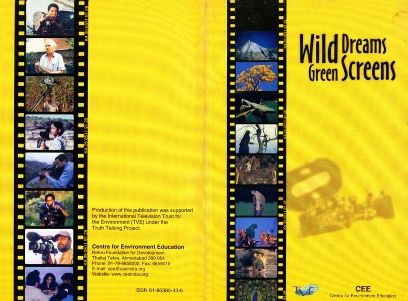
Rom’s career in film making was a byproduct of his life-long desire to bring people and Nature closer. He chronicled his venture into the world of television and film in a chapter he wrote for a book published by India’s Centre for Environment Education and TVE Asia Pacific in 2002. In that book, titled Wild Dreams, Green Screens, eight leading Indian film-makers shared insights about their careers, including how and when they decided to get involved in this field. They also talked about some of the exciting — and frustrating — experiences they have had while filming nature and wildlife.

From dreams to screen...
From dreams to screen…

In the early 1970s, Rom worked with a Russian film crew who turned up to do a sequence on snakes for a film based on the famous Kipling story, Rikki Tikki Tavi. “It was fun for me to help them figure out how to film a snake stealing an egg from a bird’s nest – and it took a whole week to do it. I was impressed by their patience and persistence,” Rom recalled in the book.

After that, every few months, some film crew would show up to do either a short news story on the Snake Park, or a short film on Indian snakes for foreign audiences. India’s stereotyped reputation as a land of snakes and snake-charmers partly fueled this interest.

Rom continues: “By the 1980s, I started thinking I knew something about making wildlife films – even though I didn’t have a TV, and there weren’t really very many such documentaries screened anywhere in India. I was aware that films could show and teach people about my beloved reptiles like nothing else. Surely the Snake Park with nearly a million visitors a year could make good use of such films, and I knew the visitors would go away with a new awareness of how beautiful, graceful and interesting reptiles are. A single broadcast on a TV channel and 20 million people would be able to see it all at once!”

Determined to do his own films, Rom teamed up with two school friends John and Louise Riber, and Shekar Dattatri, to make a film on India’s snakebite problem. They had a tiny budget (Indian Rupees 50,000, which is approximately US$ 1,000 today), an old Arri camera and ‘a lot of enthusiasm’.

One thing led to another. “‘Snakebite’ turned out to be a good little half-hour film which was translated into several Indian languages… Amazingly, this little film won a first prize at a festival in the United States, and was awarded the Golden Eagle by the American Movie and Television Federation. Lo and behold, I was a filmmaker!”

‘Snakebite’ (1985), made on 16 mm film, also launched the career of Shekar Dattatri, a multi-award winning Indian filmmaker who worked as an assistant director on this production. Coincidentally, Shekar was an Associate Laureate of the Rolex Award in 2004 for his ‘Wild India Project – Changing Hearts and Minds through Moving Images’.

Vikram Akula (left) presents Rolex Awards certificate to Romulus Whitaker in Delhi, 22 January 2009

We missed Shekar at the Delhi event – he couldn’t make it due to scheduling difficulties. But as Rom has written, the Whitaker-Dattatri partnership continued for several years while they struggled with ‘very crude equipment’ and tiny budgets. Films like ‘Seeds of Hope’ (on tree planting) and ‘A Cooperative for Snake Catchers’ followed.

Rom further writes in his chapter: “We worked hard on these films, learning as we went along month after month, working with really good people like the tree planters of Auroville and the Palni Hills Conservation Council, and, of course, the fantastic Irula tribals. We did have a few narrow escapes with snakes, but we always felt we were in much more danger driving down National Highway 45, than from any of our venomous subjects!”

Rom’s film making in the past two decades has taken him not only to the far corners of India, but to other biodiversity hotspots of the world – such as Indonesia. As the years passed, his enhanced reputation attracted big names in wildlife films, such as National Geographic, Discovery/Animal Planet and BBC Natural History. Combining his conservation knowledge with public education skills, Rom has also been presenter of several films.

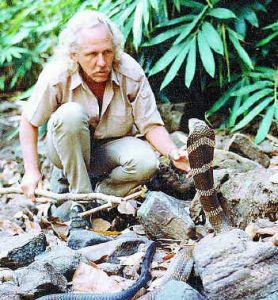
The King (Cobra) and I

These multiple involvements have earned him a string of awards – his documentary King Cobra made for National Geographic won him an Emmy award, considered the television equivalent of the Oscars.

Despite the rigorous demands of film making (and the occasional lure of television medium), Rom has remained active in conservation circles both within India and at global level. While many conservationists in India focus their attention on charismatic megafauna like tigers and elephants, Rom has stayed faithful to his chosen field of reptiles and amphibians. Years ago he realized that his beloved species cannot survive unless their natural habitats do. So, like many others, he evolved from naturalist to conservationist.

“A lot of us get wrapped up in our own little special animal and then we wake up and start thinking it has got to be habitat and it has to be eco-development that involves people and, now, in my case, it has crystallized into the whole idea of water resources,” he says.

Read his detailed CV for details on his conservation, publishing and film making accomplishments.

Rom’s colourful career has itself become a subject for other filmmakers. In 2007, he was featured in a critically-acclaimed documentary produced by PBS, under their “Nature” banner, on “super-sized” crocodiles and alligators, which was filmed in India, East Africa and Australia.

And in January 2009, Whitaker returned to the small screen in another “Nature” documentary on real-life reptiles such as Komodo dragons and Dracos that inspired tales of dragons.

Extract from The Dragon Chronicles, which premiered on PBS in January 2009:

Read the PBS/Dragon Chronicles interview with Rom Whitaker

The man who turned to moving images in the 1980s to move people’s minds towards conservation is still engaged in that business. He is a conservationist who puts a premium on public engagement, and especially on working with children and young people.

He says: “We are doing a lot of work with young people, bringing them to the forest and showing them what happens here and why it matters. It can be very difficult to change adult attitudes, but with the young, it is easier to get across the knowledge that what we are doing to the forests we are doing to ourselves.”

In Romulus Whitaker's hands, snakes become educational tools for children and icons of nature conservation. Photo courtesy Rolex Awards
In Romulus Whitaker\’s hands, snakes become educational tools for children and icons of nature conservation. Photo courtesy Rolex Awards