We as a nation collectively uttered these words as we raised our heads after the Indian Ocean tsunami of December 2004. That mega-disaster, which caught our government unawares and society unprepared, devastated many coastal areas, killing around 40,000 and displacing over a million people.
Even a 30 minute early warning could have saved many of those lost lives, by simply asking them to run inland, away from the waves. But there was no such warning.
Badly shaken by that experience, the then government reformed disaster related laws and institutions. Until then, dealing with disaster response was lumped under social services. The new system created a dedicated ministry for disaster management, with emphasis on disaster risk reduction (DRR).
Living amidst multiple hazards is unavoidable, but preparedness can vastly reduce impacts when disasters do occur. That is DRR in a nutshell.
But in immature democracies like ours, we must never say never again. Our political parties and politicians lack the will and commitment required to meet these long-term objectives. Our governance systems are not fully capable of keeping ourselves safe from Nature’s wrath.
Disaster resilience is not a technocratic quick fix but the composite outcome of a myriad actions. Good governance is the vital ‘lubricant’ that makes everything come together and work well. Without governance, we risk slipping back into business as usual, continuing our apathy, greed and short-termism.
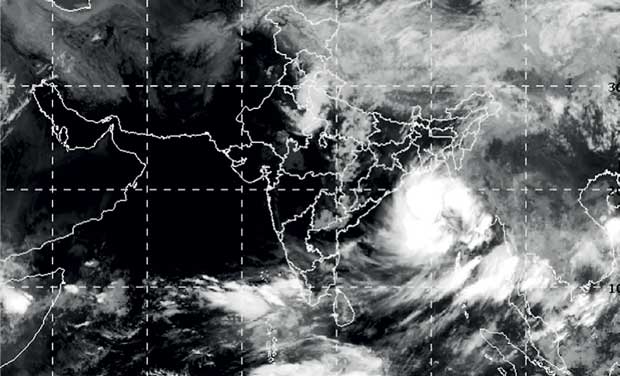
This big picture level reality could well be why disaster response has been patchy and uncoordinated in both May 2016 and last week.
Fundamental issues
As the flood waters recede in affected parts of Sri Lanka, familiar questions are being asked again. Did the government’s disaster management machinery fail to warn the communities at risk? Or were the hazard warnings issued but poorly communicated? And once disaster occurred, could the relief response have been better handled? Are we making enough use of technological tools?
Finger pointing won’t get us very far, even though public anger is justified where governmental lapses are evident. We need to move beyond the blame game to identify core issues and then address them.
In my view, two high level issues are climate resilience and improved governance.
DRR is easier said than done in the best of times, and in recent years human-made climate change has made it much harder. Global warming is disrupting familiar weather patterns and causing more frequent and intense weather. What used to be weather extremes occurring once in 25 or 50 years in the past now happens every few years.
Climate imperatives
The UN’s climate panel (IPCC) says that global average temperatures could rise by somewhere between 2 degree and 6 degrees Centigrade by 2100. This would trigger many disruptions, including erratic monsoons, the seasonal oceanic winds that deliver most of our annual rains.
That is more than two thirds of the total number of 646,500 people affected by floods and landslides in the South, as counted on June 1. But slowly-unfolding droughts never get the kind of press that floods inspire.
One thing is clear: disaster management can succeed today only if climate realities are factored in. And coping with climate change’s now inevitable impacts, a process known as climate adaptation, requires technical knowledge combined with proper governance of both natural resources and human systems.
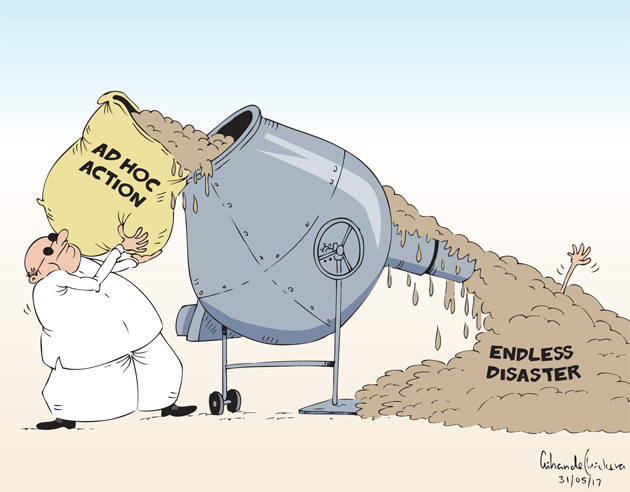
Sri Lanka: Not only oscillating between droughts and floods, but now also having both disasters at the same time. Cartoon by Gihan de Chickera
Adapt or Perish
Sri Lanka joined the UN Framework Convention on Climate Change (UNFCCC) in 1992. But 25 years on, climate considerations are not fully factored into our development planning and public investments. State agencies in charge of roads, railways, irrigation works and utilities don’t appear to realise the need to ‘insure’ their installations and operations from climate impacts.
Climate adaptation is not something that the disaster ministry and DMC alone can accomplish. It needs to be a common factor that runs across the entire government, from agriculture and health to power and transport. It needs to be the bedrock of DRR.
We need aware and empowered local communities matched by efficient local government bodies. This combination has worked well, for example, in the Philippines, now hailed as a global leader in DRR.
The selection of Nobel Peace Prize laureate often stirs more debate than all other Nobel prizes (in chemistry, physics, medicine, literature and economics) combined. The peace prize remains an essentially political one, reflecting the reality that most conflicts — and their resolution — are largely influenced by political considerations.
Members of the Norwegian Nobel Committee, all Norwegian nationals, may not be too well known beyond their country. Yet their annual selection reverberates around the world.
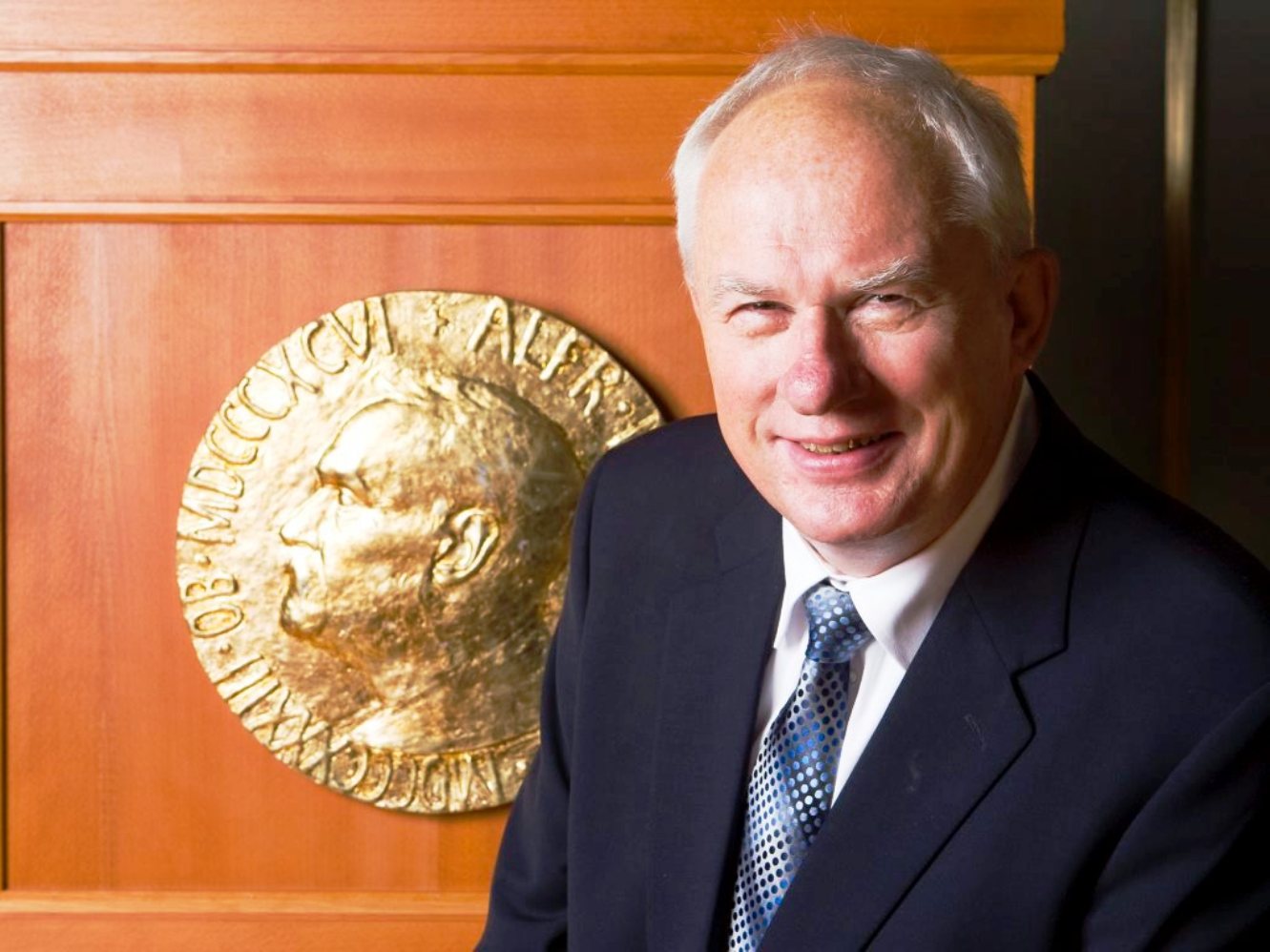
Five years ago, on a visit to the Norwegian capital, I listened to a talk by Dr Geir Lundestad, a historian who is Director of the Nobel Institute in Oslo and secretary to the Norwegian Nobel Committee. He gave some interesting insights into the legacy and limitations of the prize. I share these in my latest Ravaya column (in Sinhala) just as the winners of Nobel Peace Prize 2014 are to be announced this week.


 Open Minds!