Don’t say a word: Men, women and Bruno Bozzetto

I just wrote a blog post titled Children of Heaven: Appreciating the sound of silence. Reviewing the 1997 movie by Majid Majidi, I remarked about his strategic use of silences in his soundtrack – we must never underestimate its power in the right place.

Other creators of moving images do their magic with a good sound track – but sometimes without using a word of dialog. Here’s a clever example I’ve found on YouTube – it is by Italy’s leading animator, Bruno Bozzetto (photos below, courtesy Bruno Bozzetto website).
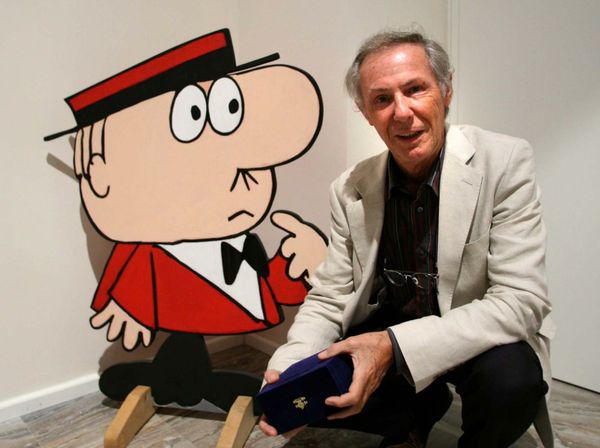
Bruno Bozzetto

Titled Femminile & Maschile (Feminine and Masculine), this 2-D animation was made in 2004. I can’t find a synopsis online, but one website introduced it simply as follows: Some situations that show the difference of behaviour between men and women in the everyday life.

Anyone with a sense of humour can appreciate this piece – and I hope that includes die-hard feminists…

Here’s the intro from Wikipedia:
Bruno Bozzetto (born March 3, 1938 in Milan, Italy) is an Italian cartoon animator, creator of many short pieces, mainly of a political or satirical nature. He created his first animated short “Tapum! the weapons’ story” in 1958 at the age of 20. His most famous character, a hapless little man named “Signor Rossi” (Mr. Rossi), has been featured in many animated shorts as well as starring in three feature films: “Mr. Rossi Looks for Happiness” (1976), “Mr. Rossi’s Dreams” (1977), and “Mr. Rossi’s Vacation” (1977). Read the rest of his profile on Wikipedia

Earlier this week, to mark Earth Day on 22 April 2008, I took part in a half hour, live interview with Sri Lanka’s highest rated, most popular channel, Sirasa TV. I wanted to relate the global to not just the local but also to the individual and family level. To discuss how our lifestyle choices and consumer decisions affect that planet, I used a series of brilliant cartoon animations that Bruno Bozzetto had done some years ago for WWF.

Again, without having his characters utter a single word, Bozzetto gives out profound messages through images and musical sound track. This is why I keep saying that when it comes to the sheer economy of words, we writers just can’t beat cartoonists.

Sorry, I can’t locate these anywhere online (YouTube lists dozens of his other creations, but not this series — which I can’t even find on his own website.) It’s time for someone to revive this series, for their message is even more relevant for today’s climate-challenged world…

Bruno Bozzetto entry on Internet Movie Database
Visit the official website of Bruno Bozzetto
Watch other Bruno Bozzetto short animations online

Children of Heaven: Appreciating the sound of silence

Courtesy Wikipedia

What’s it with children and shoes? Those who have none dream of owning their first pair. Those who have one, or some, still dream about a better, or perfect, pair. Shoes are worth dreaming about, crying (even fighting?) over, and running races for.

Like Ali did, in Majid Majidi’s superbly crafted 1997 movie Children of Heaven. For 90 minutes this afternoon, my team and I ran the race with little boy Ali, sharing his dreams, sorrows and eventual (albeit bitter-sweet) triumph.

I had seen this film before, but this time around, the experience felt even better than I remembered it. I already knew the story, but I was spell-bound by the film’s culmination – the children’s race where Ali wanted to come third, but ended up winning. I followed the last few minutes with tears in my eyes and the heart beating faster.

This is what good story telling is all about.

Read Children of Heaven synopsis on Wikipedia

Of course, Majid Majidi didn’t work this miracle alone. The superb cinematography of Parviz Malekzaade was well packaged by its editor Hassan Hassandoost. His work is uncluttered and elegant: the story flows in a simple, linear manner with no flashbacks or flash-forwards; no special effects to jazz things up; and the scenes are so seamlessly meshed together with hardly a second being wasted.

And the soundtrack played a vital part in shaping the whole experience. It’s not just the music. As my colleague Buddhini remarked, it also made clever, strategic use of silence.

We might call it the sound of silence – and never underestimate its power in the right place.

All this reminded me of what our Australian film-maker colleague Bruce Moir often said when we worked with him: “We’ve got to remember that film appeals to people’s hearts more than their minds. The way to people’s heads is through their hearts, from the chest upwards — and not the other way round.”

A year ago, I invited him as my special guest to a talk I gave at the University of Western Sydney in Australia – in his home city. There, he once again made the point: “Our fundamental job is to tell a story – one that holds an audience’s interest and moves their heart, regardless of language, cultural context or subject….I have always believed that film achieves its optimal impact by aiming to ‘get at the audience’s head via their heart’…”

April 2007 blog post: Moving images moving heart first, mind next

As I then wrote, I hope this was an ‘Aha!’ moment to some in our largely academic and activist audience. Many who commission films or even a few who make films tend to overlook this. Especially when they set out trying to ‘communicate messages’.

Bruce never tires of saying: “Film is a lousy medium to communicate information. It works best at the emotional level.”

Children of Heaven is living proof of this. It has no lofty agenda to deliver information or communicate messages of any kind. Yet, by telling a universal story set in modern day Iran, it brings up a whole lot of development related issues that can trigger hours of discussion: not just the rich/poor or rural/urban disparities, but other concerns like how a country like Iran is portrayed in the western news media.

As a colleague remarked after today’s film, she had no idea of this aspect of life in Iran — the version we constantly hear is of an oil-rich, nuke-happy, terror-sponsoring theocracy that, to the incumbent US president at least, is part of the ‘axis of evil‘. And the Al Jazeera International channel, packed with BBC discards or defectors, has done little to change this popular perception.

We watched the movie as part of our monthly screening of a feature film. We are lining up critically acclaimed films from different cinematic traditions of the world. And then we discuss its artistic, technical and editorial aspects.

As for me, I totally agree with the famous movie critic Roger Ebert, who wrote in the Chicago Sun-Times at the time of the movie’s first US release: “Children of Heaven is very nearly a perfect movie for children, and of course that means adults will like it, too. It lacks the cynicism and smart-mouth attitudes of so much American entertainment for kids and glows with a kind of good-hearted purity. To see this movie is to be reminded of a time when the children in movies were children and not miniature stand-up comics.”

As he summed it up: “Children of Heaven is about a home without unhappiness. About a brother and sister who love one another, instead of fighting. About situations any child can identify with. In this film from Iran, I found a sweetness and innocence that shames the land of Mutant Turtles, Power Rangers and violent video games. Why do we teach our kids to see through things, before they even learn to see them?”

Note: The film, originally made in Persian, was named Bacheha-Ye aseman . It was nominated for an Academy (Oscar) Award for the best foreign film in 1998, but lost out to a worthy competitor, Roberto Benigni’s Life is Beautiful.

Moving Images salute to Arthur C Clarke: 1917 – 2008

Sir Arthur C Clarke, 1917 – 2008: The Final Goodbye from Colombo

Communicating Disasters: Lessons from Titanic to Asian Tsunami by Arthur C Clarke

Arthur C Clarke’s 90th birthday reflections released on YouTube

Sputnik+50: The beep that shook the world…

The Road from Citizen Kane to Citizen Journalist

Arthur C Clarke’s climate friendly advice: Don’t commute, communicate!

Arthur Clarke looking for signs of life in Colombo…

From whales to bacteria: the adaptable science journalist

What happens when a few hundred witty, metaphor-happy journalists are let loose for a week?

They come up with all sorts of new ways to describe themselves!

First it was Australian science broadcaster Robyn Williams who compared science journalists with whales.

He suggested this analogy during the opening of the 5th World Conference of Science Journalists in Melbourne earlier this week.

Heading in the micro end of the animal kingdom, a leading South African science journalist thinks some of her kind are like extremophile bacteria: hardy enough to survive in very harsh environments.

Christina Scott was referring to the tough working conditions of many journalists – including those covering science – working in the developing countries.

She and I were part of a plenary session today on Reporting science in emerging economies which started off the final day of sessions at the conference. Others on the panel were T V Padma (India), Jia Hepeng (China), Talent Ng’andwe (Zambia) and Luisa Massarani (Brazil). All of us are associated with the Science and Development Network (SciDev.Net) in one way or another – as correspondents, regional coordinators, or in my case as a Trustee.

The session surveyed the technological, cultural, political and economic factors that stand in the way of good science journalism in developing regions of the world. We presented our experiences and perspectives on the status of our profession – and hopes for the future.

Yes, we recognised the many odds we are working against. But on the whole it was a message of resilience, adaptability and survival.

I ended my own remarks saying: Life finds a way in the harshest of environments. So does science journalism. In conditions far from ideal, science journalism happens. Not just on and off, but on a regular basis.

We are good at what I call ‘wonderful improvisation’.

SciDev.Net coverage of the Fifth World Conference of Science Journalists

Collective blog of SciDev.Net team at the conference

Personal blog of Talent Ng’andwe

Nature
blog post on our session can be read here

Thanking a supportive public…

At the end of his public talk at the Smithsonian Natural History Museum in Washington DC, Canadian naturalist and TV host David Suzuki autographed copies of his life’s story in print, simply titled: David Suzuki: The Autobiography.

Naturally, I lined up. He inscribed it as: “To Nalaka: For Mother Earth”.

Suzuki has been one of my heroes from the time I first listened to him in May 1991, at an environmental youth conference in his home town of Vancouver. That was a memorable meeting, thanks largely to the presence of David Suzuki and Anita Roddick, founder of The Body Shop and an equally passionate campaigner for social justice and environmental causes.

The Autobiography The dedication of his autobiography is moving as it is fitting a man of public science who has done much to critically communicate science, technology and environment issues through radio, television and print media:

With deepest gratitude,
I thank and dedicate this book to the general public,
who made my life’s work possible.

You watched and listened to my programs;
You read, thought about, and responded to
ideas I expressed in writing.

You support added weight and
visibility to my efforts and carried me past
numerous road blocks and detractors.

That support has been a great honour, privilege,
and responsibility, which I have tried in my fallible, human
way to live up to.

In his acknowledgements, Suzuki goes on to thank many and varied people in his life including his parents, wife, children, grandchildren — as well as ‘the dozens of CBC radio and television staff, freelance researchers, writers and media professionals whose efforts have made me look good, a job that Jim Murray (his first producer on The Nature of Things) reminded me was not easy’.

I’m reading the book that is full of fascinating insights. There can’t be too many scientists who stripped down to a fig leaf and allowed public photography — all in the name of science (see photo).
almost nothing to hide from his audiences....

If he harboured any doubts whether his life held anything of interest or value to others, he need not have worried. David Suzuki is one of Canada’s greatest living treasures.

And his audiences know it.

For more information on the autobiography, go to Amazon.com

For David Suzuki Foundation