Blogging turns 10 – Happy Birthday to Us!

“Check this out. Amazing!”

Four simple words. Yet they sparked what snowballed into a revolution of sorts on the web.

Those were the very first words to be written on the first blog.

Blogging turned 10 on 1 April 2007.

Created by the US web guru Dave Winer, Scripting News is regarded as the first modern blog, though the term “weblog” was not used in the early days.

Having first gone online on 1 April 1997, Scripting News is still going strong and is credited with helping popularise RSS and podcasting, too.

Winer himself actually calls info.cern.ch, built by Tim Berners-Lee, the first weblog because it “pointed to all the new sites as they came online”.

According to his blog (what else?), Winer, 51, pioneered the development of weblogs, syndication (RSS), podcasting, outlining, and web content management software. He is a former contributing editor at Wired Magazine, my own favourite guide to the often bewildering but fascinating digital world.

Latest figures indicate an estimated 70 million blogs in existence, with around 1.5m posts being written every day.

According to Technorati, which monitors and aggregates blogs, some 120,000 new weblogs being created worldwide each day – that’s about 1.4 blogs every second.

Oh, and what did Dave Winer want checked out? It was just a list of websites he had visited that day.


Read The Guardian (UK) article on 10 years of blogging.

Moving images moving heart first, mind next

“Film is a lousy medium to communicate information. It works best at the emotional level.”

Bruce Moir, one of Australia’s seniormost film professionals made this remark soon after I had presented TVE Asia Pacific’s Children of Tsunami experience to OUR Media 6 conference in Sydney last afternoon.

After more than 35 years in documentary and feature film production for both cinematic and broadcast industries, in different parts of the English speaking world, Bruce knows a thing or two about moving people with moving images.

I was delighted and privileged to have Bruce join my presentation. He’d come at my invitation to the conference happening in his city.

“We’ve got to remember that film appeals to people’s hearts more than their minds,” Bruce explained. “The way to people’s heads is through their hearts, from the chest upwards — and not the other way round.”

I hope this was an ‘Aha!’ moment to at least some in our audience. I’ve personally heard Bruce say this before, but it bears repetition – because many film professionals tend to overlook this. Especially those who are trying to ‘communicate messages’.

Even a few weeks ago, I quoted him in a review as saying: “Our fundamental job is to tell a story – one that holds an audience’s interest and moves their heart, regardless of language, cultural context or subject….I have always believed that film achieves its optimal impact by aiming to ‘get at the audience’s head via their heart’ rather than the other way around.”

Bruce Moir

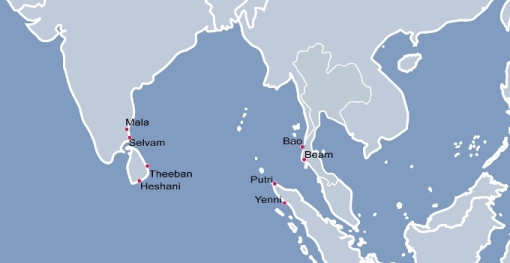
Without Bruce’s involvement, Children of Tsunami would have turned out to be very different. He was our Supervising Producer for the entire effort, advising and guiding our national film production teams tracking the progress of Tsunami survivor families in India, Indonesia, Sri Lanka and Thailand for one year afer the Asian Tsunami.

As Bruce recalled, the four teams came with different backgrounds, skill levels and film-making traditions of their own – ranging from television news and current affairs to development film-making, the type usually commissioned by UN agencies. Bringing them to be ‘on the same page’ was no easy task.

Film-makers are not particularly known for their patience or people-skills. Many I know have a ‘just-get-on-with-it-never-mind-the-niceties’ attitude. Bruce is one of the most patient persons I know: he would spend days and weeks relating to our production teams – usually by email or phone – gently nudging them in certain directions.

For sure, there’s no one right way to make a film. But there are some tried and tested principles in good story telling, which is what Bruce excels in. And which he willingly shares with others.

The year-long, 4-country and 8-location Children of Tsunami project was the biggest logistical operation TVE Asia Pacific has mounted in its 11 years of existence. (We’re in no great hurry to top that one!). Our production teams – operating from Bangkok, Colombo, Ubud (Indonesia) and Chennai – related to our regional production team based in two cities: Colombo, where TVEAP office is currently anchored, and Sydney, where Bruce lives.

We only came together face to face just once, in Bangkok, early on in the process. That meeting agreed on styles and formats, and also helped build the human relationships.

The rest of the time it was all through communications technologies. As you can imagine, lots of tapes moved around, as did many Gigabytes of video over the web. (DHL should have become a sponsor – they had lots of business from us!)

children-of-tsunami-locations.jpg

As I explained in my talk, Children of Tsunami was not just a film project. We published a monthly video report online on each of the eight families we were tracking, plus maintained a dedicated website with growing volumes of text, images and links. The monthly videos were edited and post-produced in the countries of filming, by our production teams themselves. It was distributed film-making, even if everyone worked to a common format.

With all that frenzy now behind us, the products of Children of Tsunami continue to be distributed, showcased and discussed at film festivals and conferences like OUR Media.

As I said yesterday to my predominantly academic audience: we’ve got a story telling and journalistic practice, and we now need a theory for it.

Related links:

Children of Tsunami: Documenting Asia’s longest year

Children of Tsunami revisited two years later
Digits4Change: Do ICTs make a difference?

When it comes to bridging the Digital Divide, there’s so much hype, rhetoric and confusion. For many in the UN system, it’s just another development issue to be bandied about at endless meetings and conferences, and to be reflected upon from 30,000 feet above the ground where they find themselves most of the time.

Yet, at the ground level, individuals and communities are adapting various ICTs to meet their practical needs and solve real world problems. I sometimes feel that whatever bridging of the Digital Divide will happen in spite of, and not because of, the UN agencies and other development players debating issues to exhaustion.

In 2005-2006, we at TVE Asia Pacific documented some of these efforts in different parts of Asia. We looked at a variety of technologies solving a range of problems. This became Digits4Change.

digits4change.jpg

Here’s our series intrdocution:

There are more poor people in the Asia Pacific than in all other regions combined. At the same time, some Asian countries have achieved the most advanced economies in the world. Their prosperity is partly due to how they have developed or adopted information and communication technologies — or ICTs.

How can the developing countries of Asia use these digital tools to help generate wealth, create more jobs and improve living conditions of people? Governments, private sector, civil society and researchers have been trying out various approaches for years. The World Summit on the Information Society (WSIS) in 2003 – 2005 took stock of what has been accomplished, and what remains to be done.

TVE Asia Pacific – a regional leader in using audio-visual media to cover development issues – embarked on documenting examples where ICTs have made a change in people’s lives in the world’s largest region. We investigated stories on distance learning, business process outsourcing, tele-health and rural connectivity.

The result is a new video series: Digits4Change.

Watch Digits4Change stories on TVEAP’s channel on YouTube

Read my views on the newly launched UN Global Alliance on ICTs for Development , published on SciDev.Net

Arthur Clarke looking for signs of life in Colombo…

I have finally found my legitimate claim for being unique: I don’t follow cricket.

Yes, you heard me right. Despite being born and raised in Sri Lanka, and still being based there about half of my time, I have never been a great fan of cricket. I must be the only one in my office who gets a decent night’s sleep these days. Practically everyone stays up till the wee hours of the morning watching live TV broadcasts of the ICC World Cup cricket matches taking place literally on the other side of the globe: the West Indies.

There’s now a very close nexus between television and cricket. Live broadcasts beam instantly into our living rooms the action on a cricket field anywhere on the planet. In fact, thanks to the zoom-ins, slow-motion instant replays and other techniques, those who watch a cricket match on the small screen can share the action even better than the few thousand who witness it physically at the stadium. (And the screens are no longer very small: across cricket-crazy South Asia, sales have soared for plasma screens of increasingly large – if not mostrous – sizes.)

The man who made all this possible is slightly bemused — but not one bit affected — by all this frenzy. Sir Arthur C Clarke, science fiction author, futurist and inventor of the communications satellite, sits in his living room, pondering the near and far future of humanity that he helped transform into a Global Village.

That’s the only other person in the whole of Colombo that I know who isn’t infected by the current World Cup fever. (See my other post today for views of a rare Indian who doesn’t follow cricket and instead prefers to watch old movies.)

Writing a foreword to the UNDP’s Human Development Report in 2003, Sir Arthur noted: “Today, television rules how Sri Lankans work, dine and socialise. And when an important cricket match is being broadcast live, I have to look hard to find any signs of life on the streets of Colombo.”

We might opt out of following the cricket, making ourselves rather dull conversationalists these days, but if we dare to utter even a word against this de facto religion of South Asians, dire consequences are sure to follow.

A decade ago, Sir Arthur had a first hand experience to prove this. In a wide-ranging media interview, he told a visiting Reuters correspondent that he shared some people’s skepticism that cricket was the slowest form of animal life, because it takes so long. (A Test match can take as many as five full days, and still end without a clear result!).

Having mis-heard Sir Arthur, the Reuters man filed his story saying Arthur C Clarke calls cricket the `lowest form of life’.

That was enough to stir up a mini storm. It couldn’t have come at a worse time — Sri Lanka had just won the 1996 cricket World Cup and the country was still euphoric. For weeks, Sir Arthur had to cope with irate Sri Lankan cricket fans — as he told a visiting American journalist from The Philadelphia Inquirer, ‘I had a lot of explaining to do’.

Moral of the story:
1. Be always careful when talking to journalists.
2. Keep your criticism of cricket strictly to yourself.

Human Development Report Foreword by Sir Arthur C. Clarke: Communications for Goodness’ Sake

Read my later post: Arthur Clarke’s climate friendly advice: Don’t commute; communicate!