50? In South African terms, you’re probably dead!

“How many of you are over 50?” asked Christina Scott, South African journalist and broadcaster.

Half a dozen hands went up.

“Come on, now – be honest,” Christina urged. One more hand joined.

“In South African terms, chances are that you’re already dead,” she declared.

Christina was talking about stark realities of living and dying in today’s South Africa, which is one of the highest HIV infection rates in the world.

We were at a session on ‘Life and Death in 2020: How will science respond?’ during the Fifth World Conference of Science Journalists, currently underway in Melbourne.

christina-scott.jpg Christina Scott - image courtesy IPS

Christina then asked how many in her audience were aged between 30 and 35. This time, four hands shot up.

“If you were in South Africa, you’re probably infected with HIV, and don’t know it yet — and go around giving it to others,” she told them.

After getting her audience shocked and hooked, Christina talked about how HIV is cutting across social hierarchies and colour barriers in her country.

Many intervention strategies to contain HIV have been based on the premise that when people know more, they are more likely to change risky behaviour. “We now see that greater wealth or higher levels of access to information alone do not change people’s behaviour. In fact, the middle classes lull themselves into thinking that HIV is a poor people’s disease, when it’s not,” she said.

In other words, it’s not a linear process and is much nuanced.

Christina was doubtful if Internet, PCs and online communications could make much headway in reaching out a majority of South Africans. It’s not just a lack of connectivity and computers, but a more basic absence of electricity in many areas.

To her, old fashioned radio was still the most cost-effective way to reach more people quickly.

One new ICT that has taken sub-Saharan African by storm is mobile phones. “They are everywhere, and people are using them for all sorts of things — including sexual transactions.”

She was cautiously optimistic about prospects for combating HIV. “AIDS is like a war: it’s very nasty, and causes a lot of damage. But as in war, it also spurs innovation and responses,” she said.

An AIDS vaccine is not the answer, as the virus keeps mutating and in any case distributing the vaccine to all those who need it will be a huge challenge.

Her personal wish: her daughter of 15 to get through college without contracting HIV.

Note: Christina works as Africa consultant for the Science and Development Network.

Ratomate’s best cup of tea

In another post earlier today, I quoted a doctor turned film-maker in India saying people affected by HIV are dying more from the social stigma attached to the disease than by the disease itself.

Social stigma is a wide-spread problem that confronts people living with HIV in all parts of the world.

But occasionally, we hear some good news: how community has overcome its prejudices and accepted those infected with HIV with affection and care. Usually, it happens after going through the knee-jerk reactions.

It would be very worthwhile for some research to be done on how and when community attitude changes: what are the triggers? what is the tipping point?

Five years ago, we had first hand experience of this through a film that we at TVE Asia Pacific commissioned under our Truth Talking documentary series.

The film, titled Love for a Longer Life (26 mins, 2002) was directed by leading Nepali documentary film-maker Dhurba Basnet.
dhurba-basnet.jpg

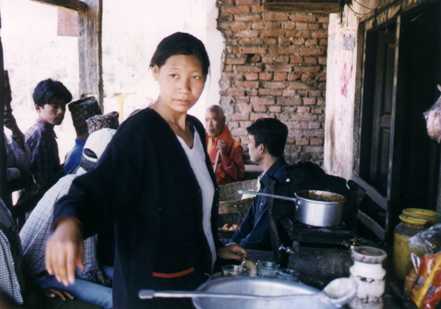
The best cup of tea in the Ratomate village, in central Nepal, is made by a woman called Laxmi Lama. She works in a tea shop owned by her father. “People tell me my father does not know how to make good tea,” she says. “They want me to make tea. The men like their tea strong. When I give my customers strong tea they say one cup is enough for the whole day.”

This is nothing unusual – except that Laxmi is living with HIV. A few years ago, no one in her village would have come near her, let along clamour for a cup of tea she makes.

Born into a very poor family, Laxmi was sold off to a Bombay brothel at the age of 14, and worked as a commercial sex worker for nearly three years before returning to Nepal. She married a man from her village and had settled down to a peaceful routine when a health worker tested her blood and found her positive for HIV. That changed everything dramatically: her husband fled, never to return, and everybody shunned her. The pregnant woman sought refuge in her parents’ house.

That was the fate of most Nepalis living with HIV – abandoned by friends, ostracised by community and left to their own devices. But thanks to the perseverance of a few courageous people – many HIV positive themselves – community attitudes have changed slowly, and have come almost full circle: being reassured that HIV does not spread through casual physical contact, they have accepted her back into their fold.

lakshmi-lama.JPG The moment of truth is when she makes Ratomate’s favourite cups of tea with her bare hands, and men and women flock to taste it. Such a major transformation of community attitudes captured in such a simple, elegant sequence.

Laxmi’s neighbour Kumari Shrestha sums it all up: “We have to give her love. If we do that, she will live longer.”

It would be wonderful if we can discern how and when this change happens. So that it can be induced in thousands of other villages and communites where persons living with HIV are currently battling the virus within, and stigma without.

View a clip from the film here.
Order the film from TVEAP e-shop

HIV: Stigma a bigger killer than the virus?

A doctor turned film-maker in India says people affected by HIV are dying more from the social stigma attached to the disease than by the disease itself.

Dr Jorge Guillermo Caravotta’s AIDS documentary Second Life was released recently. Goa-based journalist Fred Noronha’s story about this film has appeared on several websites.


An extract from the article:

India has 5.1 million HIV positive people, second only to South Africa. However, the stigma and discrimination associated with this disease are the real enemies, said Mumbai-based Caravotta, an Italian doctor of Argentine origin.

“My source of inspiration was Kamal, the first PLHA (person living with HIV/AIDS) to be my colleague,” he said.

Kamal discovered her HIV/AIDS status six months into marriage. After her husband’s death and daughter’s birth, she completed her medical studies to “live for positive people like her”, says Caravotta’s film.

“I never thought of making a documentary film about HIV/AIDS before. But after listening to her during a trip to Delhi, I found in her story a lot of courage to empower PLHAs,” Caravotta told IANS.

“India acted as an alarm clock for my film-making creativity, boosting my potential,” he added. “I would like the message of the documentary film spread all over this country with the same velocity as the virus.”

Read full article here: Doctor’s AIDS Documentary Focus on Stigma and Discrimination

A girl named Nan Nan…

Nan Nan is a young girl living in Guo Zhuang Village, in China’s Anhui province. Her parents died of AIDS sometime ago, and she now lives with an older sister — and HIV.

After her parents’ death, the two girls were shunned by relatives and left to live without adult care. “Little Flower,” Nan Nan’s teenage sister, is about to get married. She vows not to tell the groom about her sibling’s disease.

Nan Nan is one China’s estimated 75,000 (and growing) AIDS orphans. She is one of several children whose depressing story is captured in a documentary film, The Blood of the Yingzhou District (China/USA, 40 mins, 2006).

I watched this film last afternoon at the Woodrow Wilson Centre in Washington DC as part of the DC Environmental Film Festival. For me, it was one of the highlights of the festival. After all, this film won the Oscar award for Best Documentary, Short Subjects (while Al Gore’s An Inconvenient Truth won the Oscar for best documentary feature).

Notwithstanding the giggly woman moderator provided by the host institution, and even in the absence of any representative from the film’s producers – China AIDS Media Project — the audience managed to have fairly good discussion with a representative from Family Health International who was panelist to discuss the issue of AIDS orphans.

Accoring to FHI, some 15 million children worldwide have lost one or both parents to HIV/AIDS — and the numbers continue to grow as the pandemic consumes men and women of child-bearing age.

But the millions and billions don’t make much sense to most people. It’s hard to visualise more than a few thousand, let alone millions. This is something that UN agencies – all claiming to be serving the poor and disadvantaged – often forget: they dabble in the abstract, theoretical and statistical matters far removed from real people, real issues.

In that sense, films like The Blood of the Yingzhou District take us close to the unfolding human tragedies behind big numbers.
BLOOD OF THE YINGZHOU DISTRICT

This is just what we tried to do in our own Children of Tsunami media project, in which producing a documentary film was one of many outputs across different media platforms and formats.

A question was asked how the film has been received in China. The giggly moderator informed us that it is allowed to be screened in China, which is encouraging. But the Chinese response to the film has been mixed, as can be expected. See this interesting exchange online.

What impressed me the most was the film’s subtle yet powerful use of soundtrack – a good mix of music, natural sounds and spoken voices. Some featured children did seem a bit like acting at times, but that didn’t detract the film’s value too much, at least for me.

Truly a moving image creation that moves people!

See trailer on YouTube.