A doctor turned film-maker in India says people affected by HIV are dying more from the social stigma attached to the disease than by the disease itself.
Dr Jorge Guillermo Caravotta’s AIDS documentary Second Life was released recently. Goa-based journalist Fred Noronha’s story about this film has appeared on several websites.
An extract from the article:
India has 5.1 million HIV positive people, second only to South Africa. However, the stigma and discrimination associated with this disease are the real enemies, said Mumbai-based Caravotta, an Italian doctor of Argentine origin.
“My source of inspiration was Kamal, the first PLHA (person living with HIV/AIDS) to be my colleague,” he said.
Kamal discovered her HIV/AIDS status six months into marriage. After her husband’s death and daughter’s birth, she completed her medical studies to “live for positive people like her”, says Caravotta’s film.
“I never thought of making a documentary film about HIV/AIDS before. But after listening to her during a trip to Delhi, I found in her story a lot of courage to empower PLHAs,” Caravotta told IANS.
“India acted as an alarm clock for my film-making creativity, boosting my potential,” he added. “I would like the message of the documentary film spread all over this country with the same velocity as the virus.”
Earlier this year, we at TVE Asia Pacific decided to place all our short video films on YouTube.
We are always willing to try out new ways of reaching out to the various – and increasingly fragmented – publics. Any new media format or platform that comes into the public domain is to be explored and exploited to peddle our content.
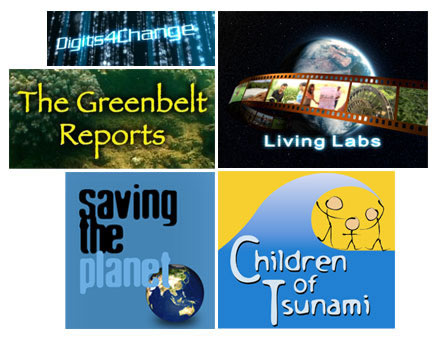
With this in mind, we launched the TVEAPFilms channel on YouTube in February 2007. We have so far placed three distinctive TV series on this channel:
Digits4Change, which explores how information and communications technologies (ICTs) are changing lives and livelihoods across Asia (6 x 5 min stories)
The Greenbelt Reports, where we revisited tsunami-affected countries in South and Southeast Asia, investigating how communities co-exist with coastal greenbelts of coral reefs, mangroves and sand dunes (12 x 5 min stories)
Living Labs, our latest series which was released this month, which profiles global action research efforts to grow more food with less water (8 x 5 min stories)
Since then, attending film festivals in Singapore and Washington DC, I realised that many documentary film-makers aren’t yet convinced about this new outlet.
‘You got your films on YouTube?’ one film-maker asked me somewhat incredulously. ‘How can you be sure someone will not download and manipulate it?’
Well, we can’t be sure. But that doesn’t prevent us from engaging this new platform. We’re willing to take these risks.
Another colleague asked: ‘But isn’t that a place for all those ameteurs?’ Perhaps. But in this digital age, the division between so-called amateurs and professionals is blurring.
Some film-makers have started placing trailers for their longer films on YouTube. Since we produce a fair number of short, self-contained films — all of which come under the YouTube’s upper limit of 10 mins — we are able to place our entire films online.
And unlike broadcast television and even passive webcasts, YouTube allows our online viewers to comment on films, and if they feel so moved, even to rank them.
At TVE Asia Pacific, we want our moving images to move people…so they join the conversation. In that sense, YouTube is a good platform to be on, and a good community to be part of.
In a 90-minute presentation at the Smithsonian Natural History Museum, Suzuki talked about his childhood, early influences, academic career and public life. He kept his packed audience – over 600 people – spell-bound, entertained and inspired. It reminded me of the first time I listened to this charismatic geneticist: in the summer of 1991, on my first visit to his home city of Vancouver.
If anything, he had got better with age but, I was happy to note, hasn’t mellowed. He still has the same passion that has made him not just a highly successful science communicator, but an ardent activist for the environmental cause and the rights of indigenous people, or First Nations.
Introducing their well-known host, Canadian Broadcasting Corporation (CBC) says:
“Dr. Suzuki is an award-winning scientist, environmentalist and broadcaster. His television appearances, explaining the complexities of the natural sciences in a compelling, easily understood way, have consistently received high acclaim for over 30 years. He is the only network television science host who was actually a practising scientist.”
In his Smithsonian talk, Suzuki reminded us that his show – The Nature of Things with David Suzuki – is the only regular science programme that is broadcast on prime-time TV in North America on a mainstream public access channel. This might partly explain, he suggested, why Canadians are better informed about science and environmental issues that affect their daily lives. (In contrast, programmes like Nova go out on niche channels.)
The Museum of Broadcasting has this to say about the programme:
“One of the longest-running television shows in Canadian history, The Nature of Things has aired continuously since 6 November 1960. An hour-long general science program, the show began as a half-hour series–an attempt, as the first press release phrased it, ‘to put weekly science shows back on North American television schedules.’
Suzuki has been presenting the show without a break since 1979, and it is now branded by his name. When The Nature of Things with David Suzuki turned 30 years in l990, Suzuki wrote in The Toronto Star that in the gimmicky world of television-land, where only the new is exciting, “the longevity of a TV series is just like the persistence of a plant or animal species — it reflects the survival of the fittest.”
Nan Nan is a young girl living in Guo Zhuang Village, in China’s Anhui province. Her parents died of AIDS sometime ago, and she now lives with an older sister — and HIV.
After her parents’ death, the two girls were shunned by relatives and left to live without adult care. “Little Flower,” Nan Nan’s teenage sister, is about to get married. She vows not to tell the groom about her sibling’s disease.
Nan Nan is one China’s estimated 75,000 (and growing) AIDS orphans. She is one of several children whose depressing story is captured in a documentary film, The Blood of the Yingzhou District (China/USA, 40 mins, 2006).
I watched this film last afternoon at the Woodrow Wilson Centre in Washington DC as part of the DC Environmental Film Festival. For me, it was one of the highlights of the festival. After all, this film won the Oscar award for Best Documentary, Short Subjects (while Al Gore’s An Inconvenient Truth won the Oscar for best documentary feature).
Notwithstanding the giggly woman moderator provided by the host institution, and even in the absence of any representative from the film’s producers – China AIDS Media Project — the audience managed to have fairly good discussion with a representative from Family Health International who was panelist to discuss the issue of AIDS orphans.
Accoring to FHI, some 15 million children worldwide have lost one or both parents to HIV/AIDS — and the numbers continue to grow as the pandemic consumes men and women of child-bearing age.
But the millions and billions don’t make much sense to most people. It’s hard to visualise more than a few thousand, let alone millions. This is something that UN agencies – all claiming to be serving the poor and disadvantaged – often forget: they dabble in the abstract, theoretical and statistical matters far removed from real people, real issues.
This is just what we tried to do in our own Children of Tsunami media project, in which producing a documentary film was one of many outputs across different media platforms and formats.
A question was asked how the film has been received in China. The giggly moderator informed us that it is allowed to be screened in China, which is encouraging. But the Chinese response to the film has been mixed, as can be expected. See this interesting exchange online.
What impressed me the most was the film’s subtle yet powerful use of soundtrack – a good mix of music, natural sounds and spoken voices. Some featured children did seem a bit like acting at times, but that didn’t detract the film’s value too much, at least for me.
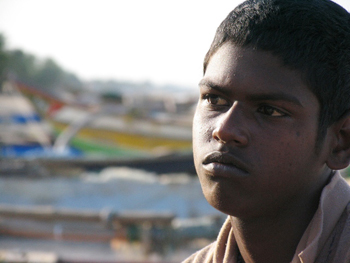
Thillainayagam Theeban (1990 – 2007)Since we started Children of Tsunami media project in early 2005, as a citizen media response to the Indian Ocean Tsunami, I have introduced it to dozens of audiences of many and varied kinds in different parts of the world. But presenting our documentary, Children of Tsunami: The Journey Continuesto the 15th DC Environmental Film Festival at the World Bank headquarters yesterday (16 March 2007) was perhaps the most difficult of all.
No, this was not a cynical audience – far from it, they turned out to be a very appreciative one, as I describe in my other post. But this was the first public introduction I had to make after we lost Theeban, the Sri Lankan boy who was one of eight children whose recovery story we tracked and filmed for much of 2005.
Theeban was murdered by unidentified gunmen who stormed into his ‘temporary’ tsunami shelter on 3 March 2007. The death is linked to spiralling political violence that is once again sweeping across Sri Lanka.
When the shocking news reached us three days later, our Sri Lankan camera team at Video Image and we at TVE Asia Pacific just couldn’t believe it. We were all in tears, and some of us were also angry. Theeban, who survived the killer waves 26 months ago (but lost his mom and kid brother in the disaster) suffered many indignities in displacement. And now, he is gone.
It’s now two weeks since Theeban was killed, but I still can’t speak about it without a lump in my throat.
That’s why I was nervous in introducing the film yesterday at the festival: I knew I was just seconds away from being stuck for words, and overcome with emotion.
My friends in the audience later said I had managed reasonably well. This is what I said as I ended my brief introduction:
“We ran out of funds to sustain our monthly filming beyond end 2005. By then we found that our film crews and we ourselves had become attached to our participating families, and especially the children who worked so closely with our film crews. We remain interested in their personal progress, even if we can no longer publish their stories.
Earlier this month, we received the devastatingly sad news that the Sri Lankan boy we filmed has been murdered –- by unidentified gunmen, right at the ‘temporary’ camp in Eastern Sri Lanka.
Thillainayagam Theeban survived the killer Tsunami waves and endured 26 months of extreme hardship in displacement — only to be swept away by the wave of political violence currently sweeping Sri Lanka.
We still don’t know who killed Theeban, and for what reasons. He was abducted by an armed group a few months ago, from whom he escaped earlier this year. It is believed that Theeban was killed as a punishment — and as a warning to all others.
He was 16 years at the time of his death. We don’t know if his killers would ever face justice.
I want to dedicate this screening to Theeban — and thousands of young people like him who are still languishing in temporary shelters, struggling to rebuild their futures.”
After the screening, there was some sympathy and empathy in the audience about Theeban. But on the whole this particular development didn’t inspire too many questions or remarks. The predominantly American audience seemed more intrigued by our journalistic documentation of how evangelical Christian groups rushed to tsunami-struck Asia, offering relief support coupled with religious conversion. (Find out more about this by watching the film online.)
Ah well, everyone takes away something different from a film like Children of Tsunami. It has so many facets and elements mixed together.
We set out asking lots of questions, and found only a few answers. We still have lots of questions in search of answers…and new ones emerging.
This was part of the 15th Environmental Film Festival in the Nation’s Capital, held at multiple venues showcasing a total of 115 films from all over the world. Good friends at the World Bank had recommended and sponsored the screening of our film.
Despite rains lashing the US capital and in the freezing cold, close to 80 people turned up to see the film, which was very encouraging. The compact auditorium was virtually full, and practically everyone stayed for the entire one and a half hour event. At the end, many of them made supportive remarks or asked good questions. It was very gratifying to present our work to such an appreciative audience.
Introducing the film, I said:
“Children of Tsunami is different from most other films in this festival. It’s not an environment film, nor is it a wildlife film.Yet it’s all about wild…life!
This film is about the aftermath of a mega-disaster, when life itself went wild, shattering the futures of hundreds of thousands of people across South and
Southeast Asia.
The Asian Tsunami of December 2004 triggered one of the biggest humanitarian relief efforts in history. It also inspired an unprecedented volume of donations and aid to the affected countries and people.
Our film begins when the media frenzy had begun to die down. We take over after most news cameras left the scene.
Indeed, Children of Tsunami started out in some anger and frustration. We were deeply concerned that most news media coverage focused on death and destruction, or doom and gloom. For sure, it was a large scale tragedy, but there were stories of courage and resilience, which we felt didn’t get the coverage they deserved.
In most post-tsunami media coverage, the affected people were portrayed as ‘victims’ rather than survivors. They were also reduced to nameless, faceless statistics. Whole countries or regions were reduced to simple blips on a map.
And then, after a few days and weeks of saturation coverage, the news media started to move on to other breaking stories. That’s the nature of our media.
But we who live and work in Asia knew the story was far from over. We knew the recovery stories would unfold for months and years to come. We wanted to keep these stories alive. We were keen to stay and move with the stories.
So in mid January 2005, we started the Children of Tsunami media project….”







 Open Minds!