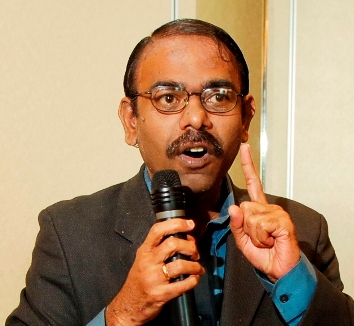
Mine is shorter than yours…yipeee!

In the topsy turvy media world, ‘conventional wisdom’ about film-making is being rapidly undone by the march of what is now known as ‘Digital Natives‘ — those currently under 30 years, who have grown up taking Internet, mobile phones and video games completely for granted.

These Digital Natives are not inclined to watch long duration documentaries. Five minutes is about right. With effort, we can get them to sit through an offering of 10 to 15 minutes. Half an hour is ‘really long’. One hour or 90 minute films — just forget it.

The sooner we face up to this reality, the better. We may not like it, but it’s not the end of the world.

In fact, it challenges us in the media to strive for greater economy of words and time.

As anyone who has worked in television news will confirm, it is indeed possible to tell a story in 100 seconds, if we package it well and carefully. Purists might call it dumbing down of television. Pragmatists would see it as customising to suit new audience realities. I go along with the latter view.

TVE Asia Pacific is not a broadcaster on its own. We produce and distribute content to over three dozen TV channels and networks spread across the Asia Pacific, now home to the world’s largest television audience. It’s through these ‘Emperors of Eyeballs’ (as I like to call them!) that we reach out.

Our broadcast partners have a good idea what their audiences want. Channel after channel tells us that the preference is for shorter, more compact programming. It would be naive to ignore this feedback and market intelligence.

The truth is: we can communicate ‘serious’ content — as long as the packaging and duration are to suit the audience realities.
That’s why TVE Asia Pacific’s recent productions have mostly followed the 5 minute format: we begin, tell and end a self-contained story in just 300 seconds.

Our recent series are examples: The Greenbelt Reports, Digits4Change and Living Labs.

The Greenbelt Reports by TVE Asia Pacific

And that’s a lot of time on screen. We have covered complex issues in exactly five minutes: for example, combating soil salinity with low cost methods; building ‘bio-shields’ of mangroves against the sea’s ravages; and using webcams and satellite links for tele-health.

These and other films continue to be broadcast and used in a range of education, advocacy and awareness efforts across the Asia Pacific and beyond.

No one has really complained about them being too short — except for some film-makers. Some have dismissed our efforts as ‘tabloid television’ and ‘not really documentaries’.

We remain unaffected. We do produce half hour documentaries from time to time, for specific purposes and defined audiences. But to ignore the mass audience trends would be to box ourselves into a tiny part of the audio-visual landscape.

We now know it is much harder to produce shorter films than longer ones. The challenge is to distill and compress without oversimplification or distortion.

So the sooner film-makers get over their obsession with length, the better. It’s not the duration of a film that matters most; it’s how a story is told. Some of the best stories are also the shortest.

To cite my favourite example from the print world, Ernest Hemingway once bet his friends 10 dollars that he could write a self-contained, full story in less then 10 words. He produced what is still considered the world’s shortest short story:
“For sale.
Baby shoes.
Never worn.”

It’s hard to beat that one for its amazing economy of words and sheer power of story telling.

How short is short today? Read leading wildlife film-maker Neil Curry’s views in my post on 27 July 2007

Read my post: Moving images move heart first, mind next

Read my post: Can you make a one-minute film for a better planet?

Radio Sagarmatha wins global award – now that’s real people’s radio!

On 23 May 2007, I wrote about Radio Sagarmatha (RS) of Nepal, South Asia’s first ever public radio station that completed 10 years on that day.

I called it Kathmandu’s beacon of hope. The pioneering radio station, entirely owned and operated by the journalists’ collective Nepal Forum of Environmental Journalists (NEFEJ), has stood by the people of Kathmandu valley — its listeners — through an eventful, sometimes turbulent decade.

And now, more recognition has come — this time in the form of an international award.

Last evening (June 14) in London’s Porchester Hall, the One World Broadcasting Trust (OWBT) presented its Special Award to Radio Sagarmatha.

I join Radio Sagarmatha’s friends and admirers worldwide in congratulating them on this latest honour.

RA Station manager, Mohan Bista, who accepted the award on behalf of his team, said: “We would like to dedicate this award to the Nepali people who fought for freedom of expression and democracy in the country, and thank them for their support through the good and bad times. We welcome the challenge and responsibility of the future.”

Announcing the selection, OWBT said:
“Based in the heart of the Kathmandu Valley, Radio Sagarmatha has irreversibly changed the landscape of broadcasting in the country. Originally built from water pipes and tested by staff driving around the streets of Kathmandu on motorbikes clutching radios, this bold venture gave momentum to the pro-democracy movement, which eventually led to the restoration of parliamentary democracy in April 2006.”

Earlier, Lord Young of Norwood Green, Chairman of OWBT, had said in a letter sent to Radio Sagarmatha: “The Trustees received a large number of nominations from as far apart as Guatemala, Zambia…. and it was inevitably a very difficult choice for them, but Radio Sagarmatha stood out because of its long-standing reputation as one of the first independent public-interest radio stations in South Asia, and the continued efforts to bring credible information to the audiences in an engaging and interactive way. The Trustees were unanimous in their choice.”

OWBT

OWBT’s official press release announcing the award said:
When Radio Sagarmatha launched in May 1997 – after five years of lobbying – it was a milestone not just for Nepal but for the whole of South Asia, marking the end of the government’s radio monopoly. The station blazed a trail for broadcasting in the country, and in its wake hundreds of commercial FM and community-based stations were set up.

When the King’s regime banned all independent broadcasters from carrying news in April 2005, the station continued its daily output. Seven months later, police raided the station, seizing all technical equipment and arresting five staff. But within days, public pressure led the Supreme Court of Nepal to issue an order to the government allowing Radio Sagarmatha to go live again.

RS employs 40 staff and 29 freelancers, and has recently gained government approval to double its transmitter capacity from 500 to 1,000 watts. RS has established a network of eight community radio stations across the country and offers technical support and in-house training for newcomers to Nepal’s radio sector. The station receives sponsorship from local organisations including Eco-Himal, as well as international agencies. It also runs a Friends of Radio Sagarmatha scheme which has so far raised over $10,000.

The One World Media Awards is one of the foremost Awards events in the UK encouraging excellence in media coverage that supports a greater understanding of the vital issues of international development. The awards recognise the unique role of journalists and film makers in bridging the divide between different societies, and communicating the breadth of social, political and cultural experiences across the globe. The 11 award categories cover television, radio, new media and print journalism.

Radio Sagarmatha is well and truly people’s radio. It’s not a government-controlled, donor-propped charade like Sri Lanka’s so-called community radio, about which I wrote earlier this month.

Full list of OWBT award winners 2007

One World Media Awards jury panels for 2007

Broadcasters united by Tsunami, but now divided again

In the broadcast industry, everybody knows each other — but then each one minds his or her own turf.

The United Nations, humanitarian agencies and advocacy groups have all tried to get media to co-operate more with each other, but these have remained largely token efforts.

Let’s face it: the broadcast media is fiercely competitive. TV networks and channels compete with each other in a given country or region. With channel proliferation there are more offerings chasing the same eyeballs.

But extraordinary situations bring out spontaneous collaboration in extraordinary ways. One such trigger is disasters.

Last December, speaking at a regional brainstorming on Communicating Disasters that TVE Asia Pacific organised with the UNDP, veteran Indian journalist A S Panneerselvan related a heart warming story of Indian broadcasters coming together on one such occasion.

The first hours and days after the Tsunami saw the highly competitive Indian news media organizations sharing each other’s information, visual and contacts in the true spirit of cooperation.

“Generally, the Indian news market is highly competitive with 18 TV news channels. They’re not willing to share visuals or co-operate. But something extraordinary happened soon after the Tsunami news broke. For the first time, none of the channels was insisting on exclusivity. They were simply downloading each other’s images, without even bothering about the rights or other issues.

“This was indeed rare. We know how many contracts have to be signed even for broadcasting 10 seconds of a cricket match. The kind of cross-flow of information after the Tsunami was amazing. All channel rivalries were momentarily forgotten.

“The only problem was with the international relief agencies, who are extremely hierarchy conscious. They were not easily available to the news media, and often they spoke only to influential Western news agencies such as Reuters and BBC.”

Panneer is now executive director of Panos South Asia. He was formerly the managing editor of Sun TV and bureau chief for Outlook magazine in India.

Read the full report of the Bangkok meeting on TVE Asia Pacific website

Lions and community radio: part of Sri Lanka’s mythical lore

Even well-meaning, usually balanced media organisations can occasionally slip, and fall for traps that damage their credibility.

I have always had the highest regard for Inter Press Service (IPS), the news agency of the majority world that presents the Southern voice and perspective. In the early days of my career, I shared an office with IPS bureau in Colombo, and still count many good friends who work or report for IPS from different parts of Asia.

Imagine my dismay and surprise, then, when this news story was carried by IPS earlier today:

MEDIA-SRI LANKA:
Building Ethnic Harmony With Community Radio

KOTHMALE, Jun 4 (IPS) – In this tea-growing hill country, about 150 km from Colombo, a state-run community radio station is creating harmony among the country’s Sinhalese, Tamil and Muslim ethnic groups by broadcasting from the villages and opening up the airwaves to people’s participation.

”People all over Sri Lanka are talking about peace, but this community radio has been doing it from the beginning,” P. Pavitheran, an announcer at the Kothmale Community Radio (KCR) told IPS.

“We don’t have any community divisions here,” added the Tamil broadcaster who also speaks fluent Sinhalese and switches smoothly between the two languages on air. “All my (assisting) staff are Sinhalese, but we’re all working together as a team.”

KCR on FM band was set up by the government-owned Sri Lanka Broadcasting Corporation (SLBC) in 1989 with 3 hours of transmission three days a week. Today, it broadcasts 12.5 hours a day on weekdays and 8 hours on weekends in both Sinhalese and Tamil. It covers a modest 20-km radius that includes 60 villages and 3 rural towns and reaches a population of 200,000. Read the full story here

IPS

This is one of those feel-good stories that news agencies like to publish once in a while, so that it counter the mainly negative stories that they carry as mirrors of society.

But in this instance, IPS has – perhaps inadvertently – peddled a pervasive myth that has been fabricated and distributed by UNESCO for over two decades about there being community radio stations in Sri Lanka.

I have lived and worked in Sri Lanka all my life, and never once come across a community radio station. In fact, this is a rare instance where successive governments for the past 20 years stand united: all have stubbornly refused to license any community radio.

There has never been, and there isn’t, any community radio in Sri Lanka in the sense the rest of the world understands that term. The fully state-owned and government-controlled Sri Lanka Broadcasting Corporation (SLBC) has several rural transmissions which masquerade as community radio, hoodwinking gullible development donors and naive foreign journalists.

As I have written in many places over the years, local communities have no control over content or management of the station. And no political content is allowed in the programming — try criticising the government in office and the jackboot of the Big Bad Babus of SLBC will come down with thunderous effect!

Let me quote from one of my published articles:

“SLBC broadcasts from all corners of the country, including stations located in remote areas. The channel involves local people in programme production, and it maintains a strongly agrarian audience. But listeners have no say in running the stations – these are managed by a tight bureaucracy in the capital Colombo, whose rigid guidelines control content: strictly no politics, and nothing remotely against the government in office.

“But, although touted as such, SLBC is not community radio, which is supposed to promote access, public participation in production and decision-making and listener-financing – where each listener contributes a small amount towards the running of the radio station.”

Read full article in Panos Features: Radio in Sri Lanka suffers as Colombo bosses call the shots

See also: Sri Lankan government’s broadcast stranglehold in UCLA’s AsiaMedia

Despite all this, if someone still insists that there is community radio in Sri Lanka, I can argue that by the same token, lions roam free in Sri Lanka’s remaining jungles. After all, the Sinhalese have a folk lore suggesting they descend from a lion.

Both prospects are equally fantastic. At least there are a couple of lions in the zoo.

Individuals are free to believe in fabrications coming out of that Paris-based myth factory called UNESCO. But responsible news organisations like IPS need to fact-check their stories lest they legitimise these dubious claims that contribute to suppressing genuine media freedom and media pluralism in Sri Lanka.

Bill Moyers & Ammu Joseph: Journalists are beachcombers…

I had an ‘aha!’ moment last week during the session on ‘Reporting the world through a gender lens’ at Asia Media Summit 2007 in Kuala Lumpur, Malaysia.

Ammu Joseph, the passionate and articulate Indian journalist and women’s rights activist, was speaking on gender sensitivity in disaster related coverage in South Asian media. She always speaks drawing on her rich and varied experiences, and offers refreshing perspectives on oft-discussed topics.

At one point, she quoted one of my journalism heroes, Bill Moyers, as saying:
“We journalists are simply beachcombers on the shores of other people’s knowledge, other people’s experience, and other people’s wisdom. We tell their stories.”

How very true!

Bill MoyersAmmu Joseph

I researched where Bill Moyers said this, and it turns out it was part of his speech accepting Harvard Medical School’s Global Environment Citizen Award in December 2004. Read the full speech, which is highly inspiring.

Reading further, I came across another Bill Moyers gem:
“One challenge we journalists face – how to tell such a story without coming across as Cassandras, without turning off the people we most want to understand what’s happening, who must act on what they read and hear.”

That is more relevant today than when he first said it: with climate change becoming the latest worldwide scare, it is indeed a huge challenge for us to report, analyse and explore issues without crying wolf.

But crying wolf is what characterised a good part of the session on reporting climate change during the Asia Media Summit. It had some good speakers, who knew what they were talking about, but was very poorly moderated by a man who had no idea what he was taking on.

That’s when I so wished we could clone a few more Bill Moyers — this planet is seriously in need of more like him!

And we need more like Ammu Joseph to tell us jouralism and broadcasting are not just industries or professions; that they involve and require more. Here’s her short profile:

Ammu Joseph is an independent journalist and author based in Bangalore, and writing primarily on issues relating to gender, human development and the media. Her publications include five books: Whose News? The Media and Women’s Issues (Sage, 1994 and 2006 — revised edition, co-authored/edited with Kalpana Sharma), Women in Journalism: Making News (Konark, 2000 and Penguin India, 2005 — revised edition), Terror, Counter-Terror: Women Speak Out (Kali for Women, 2003, co-authored/edited with Kalpana Sharma), Storylines: Conversations with Women Writers, and Just Between Us: Women Speak about their Writing (Women’s World India/Asmita, 2003, co-authored/edited with Vasanth Kannabiran, Ritu Menon, Gouri Salvi and Volga).

Read Ammu Joseph detailed profile

Read some of Ammu Joseph’s recent writing on India Together

Community Broadcasting: A way forward in Asia

In an earlier post, I wrote about what I presented to the workshop on community broadcasting and ICTs during Asia Media Summit 2007 in Kuala Lumpur, Malaysia, last week.

The workshop on ‘Connecting Communities through Community Broadcasting and ICTs’ gave us a chance to clarify key issues and concerns, and to agree on a common understanding for future action.

On behalf of our workshop, dynamic young Manisha Aryal, broadcast activist from Nepal who currently works for InterNews in Pakistan, presented our recommendations to the Summit plenary.

manisha-aryal-at-asia-media-summit-2007.jpg

Here, for the record, are the recommendations. I don’t hold my breath on this, but it’s good to synthesize a long and hard day’s work — over nine hours of talking! — into a few short paras.

Connecting Communities Though Community Radios and ICT

Recognizing the importance of community media in economic, political and social development, in promoting good governance practices, and in empowering marginalized groups and communities in participating fully in society in urban, rural as well as remote areas; and

Understanding the importance of encouraging community media initiatives that are owned and managed by communities and with material produced predominantly by, for and about communities,

We, the participants at the workshop on Connecting Communities through Community Radios and ICTs at Asia Media Summit 2007:
• Advocate for the recognition of community radio and other community media as a distinct tier of legislation and regulation, alongside public service and commercial broadcasting, thus, contributing to the promotion of “air diversity”
• Advocate for the recognition of community media practitioners as valuable, professionally competent resources who can be involved in both peer training and training of other media professionals
• Organize awareness building and sensitization programs on community radio and other ICTs’ potential in development for legislators and community broadcasters
• Invite community media practitioners and include the topic of community broadcasting prominently in regional and global meetings (for example: a plenary session on community media at AMS 2008, World Electronic Media Forum later this year, etc.)
• Organize training and mentoring sessions for Community Broadcasting practitioners with special recognition of the role of younger generations on how community radio can capitalize on the development in the ICT sector, on new ways of addressing financial and organizational sustainability, etc.
• Include Community Media practitioners in the documentation and sharing of local and indigenous knowledge, as well as other discussions on global themes (for example the discussions on GM, MDGs, etc.)
• Look for ways to ground community media initiatives to initiatives in other sectors (health, agriculture, education, etc.)
• Facilitate partnerships between efforts to promote community broadcasting and efforts to promote newer ICTs among communities such as Community Multimedia Centers, etc.
• Recognize community broadcasting stations as an effective entry point to take ICTs to the grassroots both in rural as well as urban settings.
• Document and disseminate best-practices and learnings in community broadcasting

Photo courtesy Manori Wijesekera, TVEAP

Communities are not what they used to be…so let’s get real!

I like busting myths when I see them. That’s probably the result of my training as a journalist to be evidence-based, open-minded and always ask probing questions.

This makes me popular in some circles and very unwelcome in others!

I took a few shots at persistent development myths while speaking last week to a group of Asian broadcasters gathered in Kuala Lumpur, Malaysia, for a workshop on ‘Connecting Communities through Community Broadcasting and ICTs’ in the run-up to Asia Media Summit 2007.

I was speaking during a session on ‘ICTs – Bringing Added Value to Community Radio’. ICT stands for information and communication technologies.

The first myth I exposed was what I call the development community’s ‘rural romance’ — almost exclusive obsession with the rural poor to the exclusion of similar, or even more compelling, needs of the urban poor. I have already devoted an entire blog post to this topic, so won’t repeat it here.

The next myth I tackled was the popular notion of ‘communities’.

I told my audience of researchers, activists and broadcasters: Communities are not just rural and unspoilt as some of you might imagine.

Here’s the relevant excerpt from my remarks:

What does ‘community’ meant to many card-carrying members of the development community? For starters:
• To begin with, people must be remote and rural, and in a geographically confined location.
• They are invariably poor, under-developed and living on the edges of survival.
• If they also have unique cultural artefacts or performances, that would offer convenient photographic or videographic opportunities to the development workers travelling from the city bearing gifts.

You get the idea. Now I ask you to get real.

Yes, such idyllic, hapless and romanticised communities probably exist in some endangered form in a few locations. But in most parts of the Real World (at least in Asia), communities -– both urban and rural -– are undergoing rapid transformation:
• People are on the move in search of jobs and opportunities.
• Technologies are on the move — especially mobile phones that no development agency put their money on!
• People are discerning and demanding, not blissfully ignorant or willing to settle for any offering from the outside!

These may seriously shatter some of your visions of an idyllic and ideal community, but these are essentially positive changes.

And communities no longer need to be defined merely by geographic proximity.

Newer ICTs now allow individuals scattered over larger areas to be connected via the airwaves or the web. This enables the creation and sustaining of:
• communities of practice;
• communities of shared interest/need;
• single issue agitation such as rallying around for constitutional reform, or repeal of an unfriendly law; and
• clamouring for political or democratic reforms.

So please move away from your narrow understanding of communities. Members of any of the above kinds of communities can benefit from community broadcasting.

I added that broadcasting itself isn’t what it used to be. The days of centrally manufactured content being imposed upon a hapless audience are now over.

Interactivity and user-generated content are IN.

Pompous, know-all anchors and presenters are OUT.

My plea to all my colleagues was: Things have moved on in the media world. So must we!

Read full text of my remarks to the workshop (cleaned up after delivery)
ams-2007-connecting-people-via-icts-ng-remarks.pdf

Read my op ed on Media: Step-child of WSIS? published by OneWorld in Nov 2003

Public funds, private rights: Big mismatch in Development film making

After over a decade of extensive networking with environment, wildlife and development film-makers across the Asia Pacific, I have yet to come across a single film-maker who had a ‘sufficient’ budget to make their films or TV programmes.

All the film-makers I know — and that’s several dozen — wish they had a bigger budget to do a better film. At an individual professional’s level, that’s perfectly fine. But collectively, there just isn’t enough money to go around.

And to make matters worse, the number of film-makers keeps growing faster than how available funds expand. In fact, in real terms, the volume of funding to make development films has been shrinking. That’s another story.

In most parts of developing Asia, broadcasters don’t invest much — or any — funds in productions of development films. So independent film-makers, and sometimes even producers within TV stations, have to raise that money from elsewhere.

They turn to development donors, UN agencies, philanthropic foundations, corporate sponsors and even private individuals. They have to beg, borrow – but hopefully, not steal – to create content that is of public interest and educational value.

It’s a constant struggle, but when we get things right, the social benefits can be high.

But there’s one aspect in this whole endeavour that has not received sufficient attention for too long: what happens to the copyrights of such creations?

Development donors manage funds that have originally come from tax payers in industrialised countries — in other words, public funds. When public funds are invested in creating what are meant to be public goods, such goods must remain available and accessible without restriction.

But that’s where things often go wrong.

Public (donor) funds are used to finance the production of development films, yet neither their funders nor commissioners clarify the rights situation to ensure the widest possible public access to the film/s. An individual film-maker or production company takes advantage of this lack of clarity to appropriate the sole copyright, and starts restricting public access to the film/s by locking into exclusive arrangements.

The very purpose of investing public/donor funds in the film’s production is thus defeated.

I have seen this scenario repeat dozens of times across Asia and elsewhere. Usually it involves development donor officials or UN agencies whose media knowledge is rather limited, and whose commitment to the public domain is not always sincere.

It is a contradiction to have full control of copyrights vested in private individuals when films or TV programmes have been fully funded using public funds. To the best of my understand of the public interest, that is just not right.

This is why I keep raising it at every available opportunity. At Asia Media Summit in Kuala Lumpur yesterday, I touched on this in my speech during the panel on ‘mobilising airwaves against poverty’. I said:

522445368_8a10a4f2fa.jpg

I call upon development donors to insist that all development films and other media products they finance -– with tax-payer money – will have no copyright restrictions attached.

I hope the UN agencies will also take note. Perhaps inadvertently, they often get locked into exclusive rights arrangements with single production companies or broadcasters. This should be avoided.

I am proud to announce that all international TV content produced by TVE Asia Pacific is available to broadcast, civil society and educational users anywhere in the world without any license fees or copyright restrictions. We do practise what we preach.

And let us all consider alternative approaches to managing intellectual property — such as the Creative Commons framework now gaining acceptance.

In my virew, there are at least four possible options for handling the rights of a publicly-funded film or other media product:

1. Keep the rights entirely unrestricted (copyleft), allowing unlimited commercial and non-commercial uses of the work.

2. Share the rights equally between the film-maker and the party commissioning (and financing) the film, so that both parties may pursue distribution and promotion in ways they think fit, keeping each other informed if need be, but not having to seek each other’s permission for it.

3. Reserving all rights in the party commissioning (and financing) the film, leaving none of it to the film-maker.

4. Conceding all rights to the film-maker, allowing him/her the full discretion and choice on how rights are managed (or restricted). This is as good as sending the film into a ‘black hole’ from which it may never emerge again.

We don’t advocate option 3, because we respect the right of creative professionals to be acknowledged for their work, and to share the intellectual property (many UN agencies do this, and we don’t think that is healthy or warranted).

We have been applying option 2 in all content we commission from TVE Asia Pacific, and are now actively considering option 1 as well. This is because all our films are made using public (donor), foundation or corporate funds given to us in trust. That must be reflected in the rights regime we apply on the products.

And we never allow ourselves to get locked into a single broadcaster’s copyrights regime.

This is clearly a debate that must gain momentum.

Investing public funds to create privately-held copyrights is just not right.

Photo courtesy Justine Chew, GKPS

Asian broadcasters: Make poverty a copyrights free zone!

Today was the second day at Asia Media Summit 2007 in the Malaysian capital of Kuala Lumpur. Among the topics taken up today were gender, poverty reduction and climate change — all discussed from the perspective of broadcasters.

I was part of the plenary session on ‘Mobilising airwaves against poverty’ held this morning. Among the other speakers were Walter Fust, director general of Swiss Development and Cooperation agency (SDC) and Stephen King, Director of BBC World Service Trust.

As speakers, we were asked to address these among other questions: How can we generate in media real interest in development issues such as poverty? How can we secure more airtime in educating and bringing about better ways to fight poverty? How can media put the poorest of the poor at the center of attention?

panel-on-mobilising-airwaves-against-poverty-at-ams-2007.jpg

In my remarks, I called for an on-air/off-air combined ‘assault’ on poverty, ignorance, corruption and other scourges of our time. Powerful as they are, broadcasts alone cannot accomplish this massive task, I pointed out.

Here’s an extract from my remarks:

We all know the power of moving images. Used strategically, moving images can move people to change lifestyles, attitudes and behaviour.

Indeed, the right kind of information -– whether about microcredit, contraception, home gardening or immunisation — can vastly improve the quality of life, and even save lives that are needlessly lost.

But this is not something that one-off or even repeat broadcasts alone can accomplish. We need a mix of broadcast and narrowcast approaches.

Communicating for social change is a slow, incremental process that involves learning, understanding, participation and sharing.

At TVE Asia Pacific, we work equally with broadcast, educational and civil society users of moving images. Our experience for over a decade shows that narrowcast work can reinforce and build on the initial broadcast outreach.

But that’s easier said than done. Every year, excellent TV programmes are made on different development topics. Public and private funds are spent in making these programmes, which draw in the creativity and hard work of committed professionals. Many TV channels willingly broadcast these programmes. After a few transmissions, these end up in broadcast archives. A few are adapted for multimedia use. That’s the nature of this industry.

Yet, as I pointed out, most of these programmes have a longer shelf-life. They can be extremely useful in education, awareness raising, advocacy and training. But unfortunately, copyrights restrictions are often too tight for that to happen. Even when the film-makers and producers themselves are keen for their creations to be used beyond broadcasts, the copyright restrictions stand in the way.

I said: “Broadcasters need to let go of development related TV content after initial broadcasts. They must also allow educational and civil society users greater access to vast visual archives, gathered from all over the world.”

I then repeated a proposal I first made last year, which I have since presented at the UN Headquarters and other forums: make poverty a ‘copyrights free zone’.

The idea is to have broadcasters and other electronic publishers release copyrights on TV, video and online content relating to poverty and development issues -– at least until (MDG target year of) 2015.

Read my original essay on poverty as a copyrights free zone, published in June 2006

There was a mixed reaction from the predominantly broadcast audience. I knew it wasn’t going to be an easy sell: this industry is so closely tied to copyrights and licensing in not just commercial but also emotional terms. Letting go of these rights, even in a limited way for a highly worthy cause, is a quantum leap for broadcast managers raised on strict rights regimes.

More about the reaction in a later post.

Meanwhile, here’s the full text of my remarks:

nalaka-gunawardene-speech-to-ams-2007-final.pdf

Photo courtesy Manori Wijesekera, TVEAP

Has Al Jazeera left the building?

Where is Wadah Khanfar?

This is the question that everyone kept asking as Asia Media Summit 2007 started off with what turned out to be a feeble and lop-sided panel on participatory media.

Khanfar, listed on the programme as Director General of the Al Jazeera Network, had confirmed participation and a seat was kept reserved for him on stage even as the opening panel kicked off.

The amiable moderator, Jennifer Lewis from Singapore, kept on asking for Khanfar to please come on stage. He never did.

The seat assigned for him remained empty all through the inaugural session. Some speculated if that was due to the recent reshuffle at Al Jazeera, which some interpreted as a pro-US coup in what until recently was regarded as the world’s most outspoken broadcast media network from the majority world.

I myself have been a cautious cheer-leader for Al Jazeera International. For example, on 18 April 2007, I wrote about AJI placing its content on YouTube to enable US-based viewers to watch the channel that was blocked out of many US cable networks.

AJI has been on the air for only six months, so we must reserve judgement on its performance for a while longer.

Many of us media-watchers were optimistic and hopeful that AJI would offer a much-needed counter to the blatantly one-sided and self-righteous coverage of the dominant international news channels, BBC World and CNN International.

AJI set out with a lofty agenda, saying it wants to ‘balance the information flow from South to North, providing accurate, impartial and objective news for a global audience from a grass roots level, giving voice to different perspectives from under-reported regions around the world.’

It also wanted to revolutionise English language TV in the same way it turned Arabic TV upside down, ending the monopoly of the airwaves by state broadcasters and governments.

Writing an op ed within days of AJI starting its broadcasts on 15 November 2006, I reacted to these stated ideals as follows:

“Noble ideals, indeed — and we fervently hope it succeeds, but unless it’s very careful and thoughtful, AJI runs the risk of falling into the same cultural and commercial traps that its two rivals are completely mired in.

“While CNN can’t get out of its US-centric analysis even in its international broadcasts, the BBC news team is more like a hopelessly mixed up teenager: one moment they are deeply British or at least western European; the next moment they are more passionate about Africa than Africans themselves.

“Desperately seeking legitimacy and acceptance in wide and varied circles, these two global channels have sometimes traded in their journalistic integrity for privileged access, exclusives or – dare we say it? – to be embedded.

“They have increasingly come to epitomise a disturbing trend in international news and current affairs journalism: the end justifies the means.”


Read my full essay in Media Helping Media (UK)

al-jazeera.jpg

I argued in my essay that the end does not justify the means of gathering news.

“If products of child labour and blood diamonds are no longer internationally acceptable, neither should the world tolerate moving images whose origins are ethically suspect.

So that’s the real challenge to Al Jazeera: to usher in real change, it needs to transform not just how television news is presented and analysed, but also how it is gathered.”

We have been watching — whenever we can catch it, that is — how AJI is covering the complex and nuanced world we live in. So far, the impressions are not encouraging. We have to look long and hard to tell the difference between BBC World, CNN International and AJI.

We will keep watching, and give the new kid on the block a bit more time to prove itself.

And we look at not just what’s shown on AJI, but how those pictures get there.

Read earlier post: Banned in the USA, Al Jazeera now on YouTube