The process of producing and distributing TVE Asia Pacific’s educational TV series, The Greenbelt Reports, is showcased in a new book on environmental journalism in South Asia, just published by Sage, a globally operating company that specialises in bringing out academic and professional books.
Arranged in 10 sections, the book brings together contributions from three dozen journalists, broadcasters and film makers in South Asia. It opens with a foreword by Darryl D’Monte, one time editor of The Times of India and Chair, Forum of Environmental Journalists of India (FEJI).
I co-wrote the chapter titled ‘Dispatches from the Frontline: Making of The Greenbelt Reports’ with my colleague Manori Wijesekera, TVEAP’s Regional Programme Manager. I was researcher and script writer of the 12-part, 4-country series that we made in 2006, in which Manori was series producer. The series looked at the environmental lessons of the 2004 Indian Ocean tsunami.
The title reflects the lingering print bias in media related discussions: in our case, the content we produced was disseminated on broadcast television, narrowcast DVD and online. We wielded cameras rather than pens, but are still very glad to share our experience in this book.
Keya Acharya (left) and Fred NoronhaThe publisher’s blurb says: “This collection of essays by some of the most prominent environmental journalists in Indian and South Asia gives deep insights into their profession and its need and relevance in society. It looks at this ‘specialisation’ of journalism both in the past and the present. Underlying almost all the essays is the changing nature of media in the region and the dilemmas facing environmental journalists. The varied background of the writers ensures the showcasing of a wide range of realities and experiences from the field. Contributions include essays by Darryl D’Monte, the late Anil Agarwal and Sunita Narain, among others.”
“This is the first book of its kind on environmental journalism, which would be an excellent resource to aid the future evolution of the enterprise in the region. Apart from essays from India, there are contributions from Pakistan, Bangladesh, Sri Lanka, Nepal and the Maldives. The book will interest a wide readership, any informed reader, besides journalists and environmentalists.”
It’s an honour to be part of a book which features the work of respected seniors like Anil, Darryl and Sunita – all of who have influenced my own career and I’m privileged to count among my friends (alas, Anil is no longer with us). In fact, I have either met, worked with or am friends with more than half the three dozen contributing authors of this book.
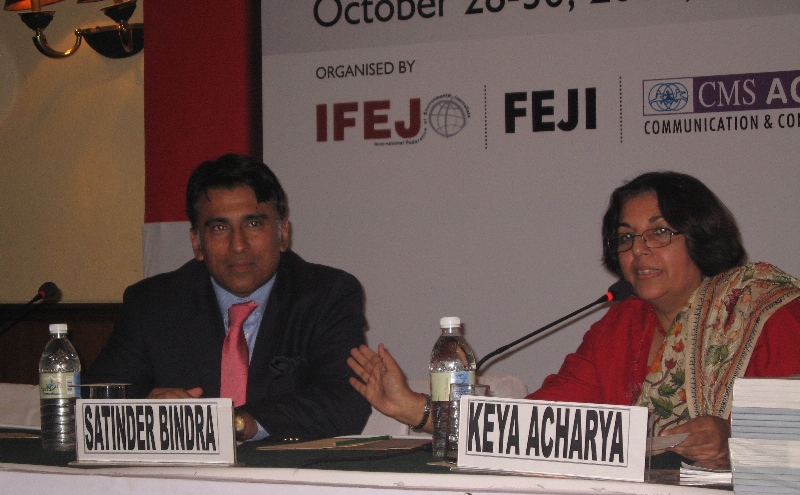
Satinder Bindra (left) and Keya Acharya at IFEJ 2009 Congress Satinder Bindra left active journalism a couple of years ago when he joined the UN Environment Programme (UNEP) as its Director of the Division of Communications and Public Information (DCPI) based at UNEP Headquarters in Nairobi. But thank goodness he still thinks and acts like a journalist.
We have gone beyond the cautionary stage of climate change, and are now acting out ‘Part II’ where we have to focus on what people can do, he said. “Climate change is no longer in doubt, and if anything, the IPCC’s scenarios are turning out to be under-estimates.”
He was referring to the IFEJ congress theme, “Bridging North-South Differences in Reporting Climate Change: Journalists’ role in Reaching an Ambitious Agreement at COP15 in Copenhagen”.
Satinder sounded emphatic when he said: “We have a limited time in which to reach as many people as possible. Environment is the single biggest challenge we face in the world today, and we as journalists have a tremendous responsibility in providing the latest, accurate information to our audiences.”
He added: “There is still a debate among journalists on whether or not we should be advocates for the environment. We should not be scared to push the best science, even if we don’t choose to engage in advocacy journalism.”
Satinder, who was a familiar face on CNN as its South Asia bureau chief until 2007, acknowledged that the media landscape was evolving faster than ever before. “Thanks to the web and mobile media, our distribution modes and business models are changing. YouTube has emerged as a key platform. Viral is the name of the game.”
His message to broadcasters, in particular, was: “You may be rivals in your work, but when it comes to saving the planet, put those differences aside.”
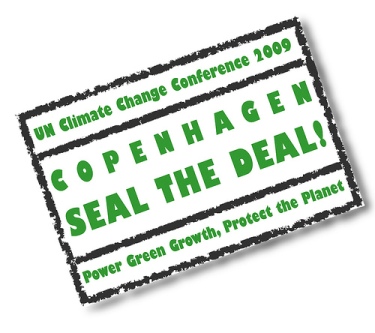
A call to the whole planet...Satinder is spearheading, on behalf of UNEP, the UN-wide Seal the Deal Campaign which aims to galvanize political will and public support for reaching a comprehensive global climate agreement in Copenhagen in December.
To me at least, the most important part of Satinder’s speech was when he said that he was not seeking to promote or position the UNEP or United Nations branding. His open offer to all journalists and broadcasters: “If you need to use the hundreds of UNEP films, or make use of our footage in your own work, go right ahead. We want you to make journalistic products. There’s no need or expectation to have the UN branding!”
Wow! This is such a refreshing change — and a significant departure — from most of his counterparts at the other UN agencies, who still think in very narrow, individual agency terms. They just can’t help boxing the lofty ideals of poverty reduction, disaster management, primary health care and everything else within the agenda setting and brand promotion needs of their own agencies.
“As development organisations compete more intensely for external funding, they are increasingly adopting desperate strategies to gain higher media visibility for their names, logos and bosses.
“Communication officers in some leading development and humanitarian organisations have been reduced to publicists. When certain UN agency chiefs tour disaster or conflict zones, their spin doctors precede or follow them. Some top honchos now travel with their own ‘embedded journalists’ – all at agency expense.
“In this publicity frenzy, these agencies’ communication products are less and less on the issues they stand for or reforms they passionately advocate. Instead, the printed material, online offerings and video films have become ‘logo delivery mechanisms’.”
Let’s sincerely hope that the pragmatic and passionate Satinder Bindra will be able to shake up the communication chiefs and officers of the UN system, and finally get them to see beyond their noses and inflated egos. It’s about time somebody pointed out that vanity does not serve the best interests of international development.
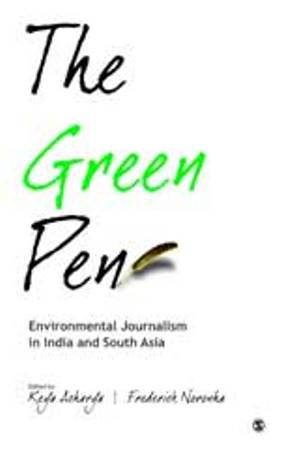 The process of producing and distributing TVE Asia Pacific’s educational TV series, The Greenbelt Reports, is showcased in a new book on environmental journalism in South Asia, just published by Sage, a globally operating company that specialises in bringing out academic and professional books.

 Open Minds!