Talking Big Foot in Yeti Land: Got a spare planet, mate?

The names Yeti and Meh-Teh are commonly used by the local people to describe the Abominable Snowman said to inhabit the deep Himalayan valleys of Nepal and Tibet. Most scientists consider this legendary ape to be part of cryptozoology – which searches for creatures said to exist but have never been documented.

But this does not take away from the allure of Yeti – it’s like the North American fascination with Big Foot.

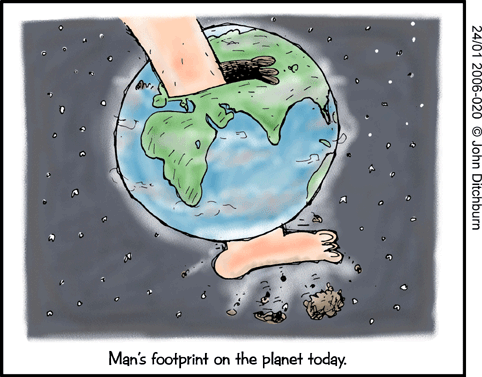
I’m spending the week at the 4th Asia Conservation Forum in Kathmandu, organised by IUCN, the World Conservation Union. Here, we have been talking about another kind of Big Foot, and the increasingly crushing footprint that this assertive creature stamps everywhere.

This, of course, is a reference to us Homo sapiens – and the growing ecological footprint (EF) that our species is generating.

EF quantifies our demand on Nature and natural systems. It measures the amount of biologically productive land and water required to meet our demands (for food, timber, shelter), and to absorb the pollution we generate.

Using this assessment, it is possible to estimate how many planet Earths it would take to support all of humanity if everybody lived a given lifestyle. For example, if everyone aspires to European lifestyles, we are going to need three planets. And for American way of life, four.

As of now, the Earth is the only naturally habitable planet that we know and have.

The term and concept of Ecological Footprint were proposed in 1992 by William Rees, a Canadian professor at the University of British Columbia.[1] In 1995, Rees and coauthor Mathis Wackernagel published Our Ecological Footprint: Reducing Human Impact on the Earth.

The Kathmandu meeting’s first substantive session, on the Future of Sustainability, heard how we are dangerously close to the Earth’s tipping point. Indian development thinker Ashok Khosla, UNEP’s regional director Surendra Shrestha and other leading analysts presented unmistakable indicators for this trend.

This resonates with a new report that came from WWF in late 2006, which concluded that our global footprint has already exceeded the earth’s bio-capacity by 25% in 2003. This meant that the Earth could no longer keep up with the demands being placed upon it.

2006-020-footprint-on-the-planet.gif

The WWF Report has presented this graphically by sorting countries as eco-creditors and eco-debtors. Much of Asia falls into the latter category (map, below, courtesy BBC Online):


So here’s the news headline from YetiLand: we have finally met Big Foot. And it is us.

Anita Roddick: We shall always remember you

Image courtesy Treehugger

“Remember me!”

That’s how Anita Roddick, who died on 10 September of brain haemorrhage, autographed for me a copy of her book Taking It Personally: How to make Conscious Choices to Change the World.

You’re hard to forget, I told her at the time. And suddenly, memories are all we are left with. And what vivid ones!

Dame Anita Roddick (1942 – 2007), founder of The Body Shop, is one of the most unforgettable persons I have met. And now that she has moved on, far too soon, her memory challenges us to persist with the social, humanitarian and environmental causes that she so passionately championed.

Media obituaries described her as the ‘Queen of Green’, but Anita was much more than just green. She stood for justice, fairness and equality in both business practices and her campaigns. From ethical sourcing of raw materials for her beauty products to agitating for human rights and humane globalization, she was one activist who walked the talk.

“I came out of the womb as an activist. I’m part of the 1960s; it’s in my DNA,” she wrote in Newsweek earlier this year. “So the idea of dying with loads of money doesn’t appeal to me at all.”

She added: “I want to use the last years I have to get my hands dirty working for civil change. I want to be able to see the positive difference that money can make by giving away what I have.”

It’s not immediately clear if she made much headway with that, but the recently set up Roddick Foundation is the latest of a long line of campaigns, social projects and charities that she founded, energised or supported.

Her business acumen and commitment to global justice have been eulogised for years. She was equally adept in using the media and communications to draw attention to a cause, issue or incident.

Without going to any business school, Anita built up a global business that had over 2,200 stores in 55 countries by the time she let go of the company in 2004. And without attending any communication school, she became one of the best communicators of our troubled times – speaking eloquently for her company’s ideals and various charitable causes.

It all came from the heart, and it was passion –- not cold facts or even colder logic -– that drove her to be a phenomenally successful communicator.

Anita loved to say: “The job of a citizen is to keep his mouth open.” And her advice to activists was: Get Informed. Get Inspired. Get Outraged. Get Active.

Never underestimate the power of one, she said. As she liked to put it:
If many little people
In many little places
Did many little deeds
They can change the face of the Earth

And like the Energizer bunny, but with lot more purpose, she kept going, going and going. She loved the Dorothy Sayers quote: “A woman in advancing old age is unstoppable by any earthly force”.

It was on one of her many world travels that our paths first crossed. In the summer of 1991, I was invited to give a workshop at Youthquake, a Canadian environmental conference building up momentum for the Earth Summit scheduled for the following year. It was here that I met two of my all-time favourite activists: geneticist-turned-TV presenter David Suzuki, and Anita Roddick. The celebrity guest was Mutang Tu’o, a representative from the Penan indigenous tribe from Sarawak, Malaysia, whose jungles were in imminent danger of being logged.

Youthquake was part conference, part youth jamboree and altogether a great deal of fun. Anita turned up with her youngest daughter Sam, and spent hours just telling real life stories in her inimitable way – full of laughter and making fun of power and pomposity. After all these years, I can’t remember anything about what I myself spoke, but I know Anita’s remarks had a lasting influence.

In those heady days before the Earth Summit, email and the global Internet, activists had an easier and simpler choice of adversaries — Uncle Sam and World Bank usually came up among the top five. When economic globalization gathered pace, things became more complex and nuanced. Ah, for the good old days!

Anita marched fearlessly into this new world where corporate fortunes are being made at the speed of light, governments are waging wars to the tune of media-entertainment industries, and certain development agencies have turned poverty reduction and HIV/AIDS into cottage industries.

Marshall all facts, get analysis right, take your firing positions and never give up the good struggle, she seemed to suggest: there’s a war out there, and it wasn’t just in Iraq and Afghanistan.

In fact, Taking It Personally was her rough guide on how to tame run-away globalization. For it, Anita invited the top thinkers in the struggle for humanitarian trade policies to weigh in on the problem, and to give citizens the tools and inspiration to do work for constructive solutions. Among its contributors were Vandana Shiva, Paul Hawken (Natural Capitalism), Naomi Klein (No Logo), and Ralph Nader.

When she autographed a copy for me, she added with a mischievous grin that the book’s US distributors had been coerced to withdraw it. She showed a possible reason: that famous photo of President George W Bush reading a book with a young child — while holding it upside down!

It’s this topsy turvy, cruel world that Anita Roddick tried to make slightly better in a thousand different ways. We fellow travellers will sorely miss her, but there is ‘no bloody alternative’ but to just slog on.

— Nalaka Gunawardene; Kathmandu 12 September 2007

Read my earlier post: Anita Roddick, Angkor Wat and the ‘Development Pill’

BBC Online: Dame Anita Roddick dies at 64

Look, no Kleenex: Way to blow our noses without blowing our planet

In the Fall of 2004, I was on a Cathay Pacific flight from Hong Kong to Toronto. The flight across the vast Pacific was 13 hours long, and half way into the flight my nose started playing up.

Being in cold placed for many hours sometimes triggers my catarrh, but I was prepared. I always carry one or more handkerchiefs with me, especially on flights. And also some anti-sneeze pills from my homeopathy doctor.

Blowing my nose and popping the small, sugary pills hardly ever draws anyone’s attention, but on this occasion it did. Our friendly flight stewardess was quite amused to see me using a hanky.

“Oh, Sir, you’re such a gentleman!” she exclaimed.

It took me a few seconds to figure out what she meant. Then she added, helpfully: “You still use a handkerchief. That’s so charming. No one uses them anymore…”

There wasn’t the faintest tone of sarcasm in her voice. She was genuinely impressed that I carried a hanky.

Image courtesy Boeing Co

I was reminded of this incident when reading Time magazine’s recent reflective essay on ten years after Princess Diana’s death.

At one point, it quotes Dickie Arbiter, a former press secretary to the Queen, Charles and Diana who was responsible for the media arrangements for Diana’s funeral: “The Queen was always going to pay tribute to Diana….There was a furor because she was at [the Scottish castle] Balmoral and not down with the sniveling mobs in London. [But] William and Harry needed her more than hundreds and thousands of people keeping Kleenex in business.”

Indeed, Kleenex and other tissue paper manufacturers must have done very nicely that week. A few days later, the death of Mother Teresa in Kolkata (formerly Calcutta) would have profited the Indian peddlers of the flimsy paper that more and more people seem to find indispensable.

Tissue paper vs. Handkerchiefs is an on-going debate that’s far from resolved. Both items have pros and cons; they also have their defenders and promoters. Some of them air their views on the Bottledguy blog

I have always been a handkerchief user, so I’m naturally biased in their favour. Yes, I have to be careful in using and storing them; yes, I have to wash, dry and keep track of them. And no, I don’t mind these chores at all.

And everything I read tells me it is more environmentally friendly to use hankies.

Here’s an interesting story from Pittsburgh Post-Gazette (3 Sep 2007): Can Australian sisters bring back hanky’s heyday?

It’s about two sisters in Australia, one in Sydney and the other in Brisbane (that I passed through only a few days ago) trying to revive the use of handkerchiefs.

They market them as “both useful accessories and as markers of the bonds between people.”

Image courtesy Hanky Schmanky

Their company is named Hanky Schmanky. I don’t know them, but applaud their initiative. They are trying to make hanky use ‘cool’ again.

We need many more people like Jennifer Moran and Angela Galgut – co-founders of this small company – to help us blow our noses without blowing the planet.

Hankymania page from Hanky Schmanky website


Nothing to Sneeze at: Umbrak Fisk gives environmental advice to all nose blowers at Grist.org