Unseen women, unheard agonies

In January 2008, I wrote about Lakshmi and Me, a recent Indian documentary that portrayed a domestic worker woman whom my friend Kalpana Sharma aptly called an invisible superwoman.

A colleague who read my piece reminded me about a series of five short films on working women in Sri Lanka that I had executive produced in 1999-2000. Produced originally in Sinhala for a national audience, the series was titled Oba Nodutu Eya (The Unseen Woman). In fact, it featured not one but several women workers in two different sectors in the country’s informal economy: the coconut husk (coir) industry in the south and agricultural settlements in the Dry Zone in the north-central areas of the island.

The following is adapted from a story I wrote about this series for a book that TVE Asia Pacific published in 2002. I have not gone back to my sources to check how much – or how little – has changed in the past several years.
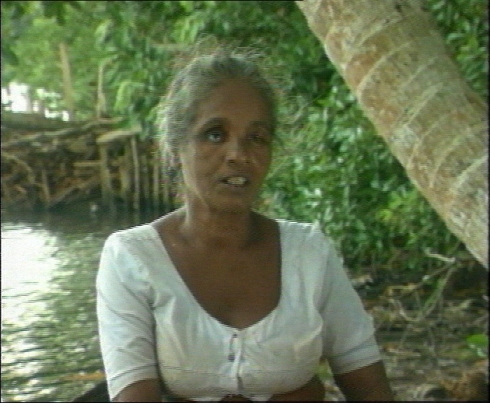
yasawathie-from-a-voice-without-a-sound.jpg

This is Yasawathie. She has suffered physical and mental abuse most of her adult life. Her alcoholic husband beat her regularly for years, but she dared not complain for fear of reprisal.

“He injured my head, stabbed me and once fractured my arm” she says, showing a scar of a healed wound.

As if this suffering was not enough, she lost sight in one eye a few years ago in a bizarre hospital accident. She had gone to the government hospital seeking treatment for a chest ailment. There were more patients than beds, so she was forced to sleep on the floor. While sleeping, a nurse carelessly dropped a saline stand on to Yasawathie’s face.

The entire incident was hushed up, and the poor woman was intimidated into silence. “Sometimes patients even die at our hands,” the nurse told her threateningly.

Injured by the healthcare system, battered by her own husband and pressurised by her family circles to keep quiet about, this middle aged Sri Lankan woman has run out of options. She was not aware she could claim damages for the accidental loss of her eye. She does not realise there is legal redress for domestic violence – her family and in laws wouldn’t allow it in any case.

Sadly, Yasawathie is not alone. There are tens of thousands of women like her who live on the margins of society, and whose suffering goes largely unnoticed. The island nation is often cited as a South Asian success story: its women were the first in Asia to vote; female literacy is nearly universal; and a higher percentage of girls and young women are in school than boys.

But hidden beneath these national accomplishments, there are huge gender-based disparities and gaps, especially in economic, labour, family and property related matters. Studies have found that many women, particularly the poorer ones, don’t know their human and legal rights.

And even women who do know their civil and political rights often do not assert their right to safeguard themselves from domestic violence or gender-based discrimination in family and society.

Yasawathie’s story was one of several that were featured in a television documentary series that probed how Sri Lankan women’s economic and legal rights operate in the real world. Produced in 1999-2000 by TVE Asia Pacific in collaboration with the Sri Lanka Environmental Television Project (SLETP), the series went beyond the oft-repeated claim of women’s emancipation in Sri Lanka. It uncovered a shocking reality of wide spread rights denial, physical abuse and gender-based violence.

The series used a mixture of short drama segments, interviews and background commentary. “These films don’t offer comprehensive surveys of the situation, but they provide useful glimpses of how economic and legal rights apply at the grassroots for women,” said accomplished fim-maker Inoka Satyangani, who directed the series. “We raise broader concerns, and point out changes that society needs to make to ensure that women can assert their rights.”

Violence against women is both a public and private matter in Sri Lanka, says the Committee on the Elimination of Discrimination against Women (CEDAW), a body of global experts which monitors whether governments are honouring their commitments to the 1981 United Nations’ Women’s Convention. Although violence affects women of every class and ethnicity, it is seldom reported.

In recent years, human rights abuses in Sri Lanka’s conflict ridden north and the east have received international scrutiny; both the government forces and Tamil Tiger rebels have committed atrocities. But violence against women is not confined to the war or the conflict-affected areas: as one rights activist has remarked, “everyone becomes part of the larger system of brutality”.

CEDAW has stressed that Sri Lanka needs specific legislation to address violence behind closed doors.
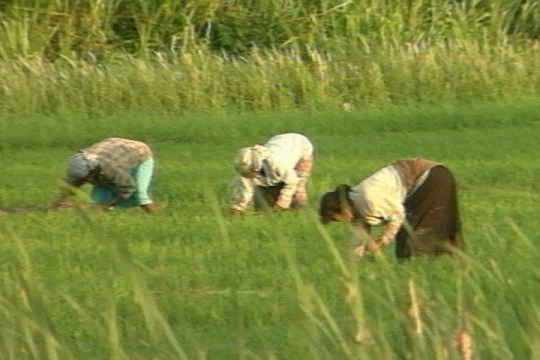
from-oba-nodutu-eya-tv-series.jpg

The TV series also found how women get paid less than men for agricultural manual labour, and how government-driven land development schemes favour men to inherit state land distributed among the landless. Government agricultural extension programmes help male farmers to obtain skills training, credit and subsidies while women farmers are constantly ignored. Women interviewed had stories that shattered the myth of women’s liberation and equality in Sri Lanka.

Read individual synopses of the five films in The Unseen Woman series

Read recent blog post: Half the sky, most of the suffering and seeking everyone’s attention

From footprints to handprints: Treading lightly on Earth…

Nalaka Gunawardene

This is me making an impression at the Global Knowledge 3rd Conference held in Kuala Lumpur, Malaysia, in December 2007. Everyone was asked to dip a hand in a saucer of paint and then press it on a large sheet of paper. In the end it created a montage of hand prints from people all over the world.

The idea was a neatly symbolic one, but as with everything else at the GK3 conference (and with its organiser, the GKP), it didn’t go any further. Good intentions, poor implementation.

But the same concept of hand print was used far more cleverly and innovatively at another large international conference I attended in November 2007. The 4th International Conference on Environment Education , hosted by the Government of India and co-sponsored by the UNESCO and UNEP, was held at the Centre for Environment Education (CEE), Ahmedabad. That multi-faceted event saw the launch of several initiatives, including Handprint – action towards sustainability.

The concept of Handprint is to decrease our ecological footprints by taking more actions towards Education for Sustainable Development (ESD).

Ecological Footprint (EF) as a concept has been around for over 15 years. The term and concept of Ecological Footprint were proposed in 1992 by William Rees, a Canadian professor at the University of British Columbia. In 1995, Rees and coauthor Mathis Wackernagel published Our Ecological Footprint: Reducing Human Impact on the Earth.

EF quantifies our demand on Nature and natural systems. It measures the amount of biologically productive land and water required to meet our demands (for food, timber, shelter), and to absorb the pollution we generate. Using this assessment, it is possible to estimate how many planet Earths it would take to support all of humanity if everybody lived a given lifestyle.

For example, if everyone aspires to European lifestyles, we are going to need three planets. And for American way of life, four.

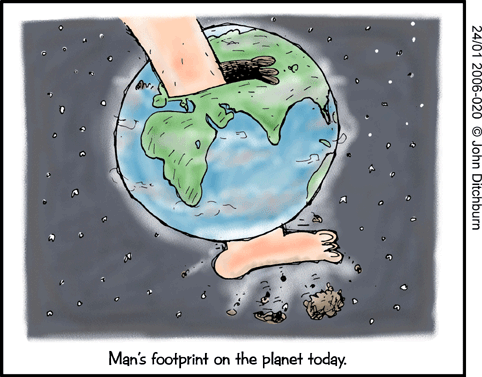
As of now, the Earth is the only naturally habitable planet that we know and have — which drives home the point that we have to contain, and eventually reduce, our ecological footprint. Some, like this cartoonist, fear that it’s already too late…

Read Sep 2007 blog post: Talking Big Foot in Yetiland

2006-020-footprint-on-the-planet.gif

Ecological footprint is a useful – in fact, revealing – measure of our species living beyond its ecological means. But it’s an inherently negative one. This is what promoted our colleagues at CEE – an internationally acknowledged centre for excellence in education for sustainable development – to come up with the related, but wholly more positive, concept of Handprint.

Whereas footprint measures our impact on the planet and its resources, Handprint will help quantify what we do to tread lightly on Earth — reducing our consumption of energy and resources, and being more considerate about the waste we generate.

As CEE says, there are many drivers of change to lessen the footprint. ESD is one of the important ones. Others include technology, policy, legal measures, systems and financial incentives.

Handprint is specifically a measure of ESD action. In the presence of over 1,000 officials, educators, activists and youth, Handprint was launched with the call: Increase your handprint; decrease your footprint!

A new website will soon be online at http://www.handsforchange.org, expanding on this concept.

While CEE is taking the concept to a whole new level and to millions who need to know and heed this message, the idea itself has been talked about by others for sometime.

For example, in May 2006, Alex Steffen wrote about it in the highly informative and inspirational website Worldchanging.

Steffen, who is executive editor of Worldchanging, wrote: “If we can imagine going climate negative, why can’t we imagine shrinking our ecological footprint until we zip past having any negative net ecological impact at all, until the operation of our daily lives heals the planet instead of hurts it? Until we transform, as I’ve said before, our ecological footprints into ecological handprints?”

TVE Asia Pacific‘s Saving the Planet TV series, currently in production, will feature a number of initiatives that will have a positive Handprint on the environment in selected countries in the Asia Pacific.

Clearly, Handprint is an area where interest and action will grow in the coming months and years.

Watch this space.

Related: Sep 2007: Way to blow our nose without blowing the planet

Photo courtesy Sasa Kralj

When citizens turn on journalists…

My latest op ed essay has just been published by Asia Media website of the University of California Los Angeles.

It’s titled: When citizens turn on journalists
Nalaka Gunawardene describes the disturbing trend of vigilantism against professional and citizen journalists

Once again I talk about the multiple pressures and risks faced by mainstream and citizen journalists alike when they try to cover matters of public interest in my native Sri Lanka. This is particularly so for photojournalists and videographers who simply must go out with tools of their profession.

Here are the few opening paras:

Friday, February 29, 2008

Colombo — For over two decades, Sri Lanka’s state-owned radio and television stations — located next to each other in residential Colombo — have been heavily guarded by police and army. This fortress-like arrangement is due to their being high on the list of targets for Tamil Tigers engaged in a bitter separatist war for a quarter century.

The joke is that the stations are just as likely to be attacked by outraged listeners or viewers. Considering the endless state propaganda they dish out day and night, that’s not as far-fetched as it sounds.

But shooting the messenger never solves any problem, as Sri Lanka’s deeply divided combatants — and their die hard supporters — need to be constantly reminded. Attacks on journalists and media organisations have increased several fold in the past two years, and the World Association of Newspapers ranked Sri Lanka as the third deadliest place for journalists (six killed in 2007) — behind only Iraq and Somalia.

As if this was not depressing enough, we have seen another disturbing trend emerge: authorities and citizens alike turning on reporters and photojournalists in public places, suspecting them to be agents of mayhem and terror.

Read the full essay on UCLA Asia Media