Can you make a one minute film for a better planet?

One minute – or 60 seconds – is a lot of time on the air. Our friends in radio and TV broadcasting know this well.

And with shrinking attention spans, many news items on TV are now being packaged for a minute, or not much longer.

Now, Friends of the Earth (together with FilmMinute) are challenging us all to come up with very short films that are one minute long — and still pack a message that benefits our planet.

Image courtesy FoE UK

Their challenge: make a film of exactly 60 seconds which explores how we look after our planet and use it like there is a tomorrow.

Here are the key rules of the game:

60 seconds – no more, no less.
Ideally broadcast quality.
Consider audience – Internet, TV, phones, etc.
Contributors must be the sole author(s).
You can submit more than one film.
No unlicenced use of copyrighted material.
No rude, unlawful or discriminatory material.
No promotion of products or services.
Some prizes are only open to UK residents.
All green one-minute films can be entered, regardless of previous screenings and awards.

Deadline is 20 August 2007. That should give us plenty of minutes to come up with some really compelling one minute films.

Image courtesy FoE

Helpful links:

Making your greenfilm


How to submit your film (via YouTube!)

Competition rules and regulations in detail

Awards and prizes
FilmMinute – the international one minute film festival: make every second count

Thank you, Brundtland. Now for the unfinished business…

On 2 April 2007, I posted excerpts from a speech I made in Hyderabad, India, on the worldwide influence of Our Common Future, the final report of the Brundtland Commission on Environment and Development that came out 20 years ago this month.

I have now expanded on that theme in an op ed essay titled ‘Children of Brundtland coming of age’.

It has just been published by Green Accord, an Italian non-profit group that every year organises a gathering of leading environmental experts and journalists. The GreenAccord Forum on Media and Nature, held in an Italian city every Fall, is now the largest, regular gathering of its kind. I have been a participant or speaker at three past editions.

GreenAccord logo

Here are excerpts from my essay:

Brundtland did not invent the concept or term -– various versions had been around since the first UN Conference on the Human Environment (Stockholm, 1972). But it was Our Common Future that took these mainly academic and inter-governmental discussions to a mass audience.

In doing so, it nudged the environmental movement to move up from simple pollution prevention, tree-hugging and whale-saving action to a much broader developmental agenda. Issues such as poverty, international trade, peace and security were integrated into one framework.

And, equally importantly, the report inspired a whole generation of young journalists, educators and activists worldwide. I was one of them: in that sense, we are all Children of Brundtland.

By happy coincidence, the report came out during my first year in science journalism, and significantly altered my outlook and priorities. My early fascination with mega-science topics such as space travel, genetic engineering and nuclear power gave way to an interest in issues of science for human survival and development. I haven’t looked back.

Some environmental journalists at GreenAccord Forum in Nov 2006

I then go on to question the continuing relevance of environmental journalism, and suggest that this kind of labelling has, inadvertently, ghettoised the media coverage of sustainable development issues.

I argue that we urgently need simple good journalism that covers sustainable development as an integral part of the mainstream of human affairs.

“We can’t engage in shoddy journalism in the name of saving endangered species or ecosystems. There is no substitute for plain good journalism.”

Photos courtesy: Zilia Castrillon

Read my full essay here

TVE Asia Pacific website news item on the last GreenAccord Forum in October 2006

The view from a Dhaka gutter: South Asia’s urban nightmare

There I was, coming out of a Dhaka gutter, badly shaken and splattered with the mega-city’s assorted muck.

A minute earlier, I had stepped right into it in the semi-darkness of the evening. I had no idea it was coming. One moment I was walked on the side of a busy but not-too-well-lit street in the Bangladeshi capital. The next, I was thigh-deep inside an open drain carrying municipal waste and drain water.

In the fading light, the blackness of the tarred road and the gutter water merged seamlessly, creating an illusion of solid surface.

My friend Shahidul Alam (below, right, with me in a happier moment), who was a few feet away, moved fast and pulled me out. As I felt my legs and feet, I realised how lucky I had been: in spite of falling two feet deep, I was unhurt – no cuts and bruises, not even a scrape (thank goodness I was wearing shoes).

Shahidul was taking me out for dinner, and then to the airport, but Dhaka’s evening traffic had wrecked our plans. We were caught in an enormous jam caused by Bashundhara City, the US Dollar 100 million shopping mall said to be South Asia’s largest (and 12th largest in the world). There was some incongruity in that, but we were keen to get to a restaurant where we had a rendezvous with some other friends.

In the event, we were too delayed and I was risking missing my flight. So Shahidul, the excellent host that he always is, decided to buy me some take-away food that I could eat on the way to the airport. He parked his car near a wayside eatery, and called me out to choose what I’d like.

I was walking a few steps behind him when I fell into the open, concealed gutter.

If I had to fall right down to Earth, I couldn’t have chosen a better date: it was Earth Day, 22 April 2006.
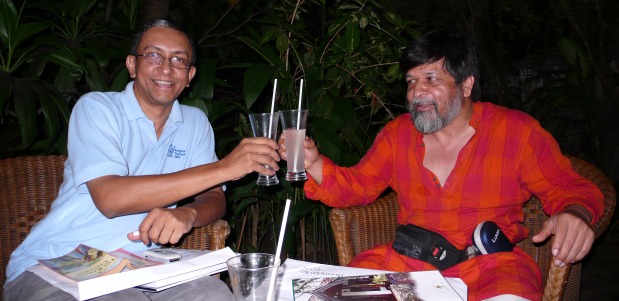
nalaka-gunawardene-left-and-shahidul-alam.jpg

After I was pulled out of the gutter, we had to move quickly. I was three hours away from my flight to Singapore, and there was no way any airline would carry someone in my condition. I had already checked out of my Dhaka hotel, and in any case that was almost two hours behind us in another part of the city.

Shahidul approached the staff in a nearby restaurant – a very ordinary one – and explained what had happened. The Bengali hospitality and kindness snapped into action. I was given immediate access to their modest wash room, where I washed and changed into clothes pulled out of my travel bag.

I had to reluctantly dump my well-used pair of shoes. Shahidul lent me his sandals, and found a taxi to rush me to the airport while he’d team up with the others to join the belated dinner.

I made it to the airport – and the flight – in good time. And as far as I could tell, no one gave me strange looks as I winged my way to Singapore. After all that excitement, I even managed to get some sleep on the flight.

But I had no illusions about what happened. For one thing, I’d escaped with no injury of any kind. For another, I had merely glimpsed and only very slightly experienced a daily reality for millions of city dwellers across developing Asia.

I should know. I live in suburban Colombo, the Sri Lankan capital, which has its own problems of waste disposal and cleanliness. The only difference is that in mega-cities like Dhaka (estimated population close to 12 million), the issues are multiplied and magnified.

We who live in middle class ‘oases’ within these cities tip-toe around the worst realities that the poorer citizens grapple with on a daily basis. They lack the choices that we have.

As a development journalist, I’ve written about urban sprawl, mega-cities and environmental challenges in developing Asia, where more people are now living in cities than ever before in history. UN Habitat says half of humanity has now become city dwellers. With their misleading image as centres of vast opportunity and prosperity, cities are a magnet to millions of rural poor. Like Dick Wittington, who thought the streets of London were paved with gold, they migrate to towns and cities in search of better lives. Most end up swelling the already burgeoning cities, exchanging their rural poverty for urban squalor.

Falling thigh-deep into a Dhaka gutter for a minute or two is no big deal when compared to the unsafe, unclean environments that they live in, every day and every night.

And they can’t just walk into a wayside restaurant, wash away the muck, and catch the next flight to clean, safe and landscaped Singapore.

Read my December 2006 essay, Grappling with Asia’s Tsunami of the Air

Photograph by Dhara Gunawardene

Tabloid journalism – and MTV’s Environment News

What can be done to lure more young audiences to care for and discuss about issues of science and technoloy?

This question was put to a panel on ‘Science and television’ that I was on last week at the Fifth World Conference of Science Journalists in Melbourne, Australia.

Each panelist offered suggestions. Mine was just three words: think more tabloid.

Those who try to communicate science to the non-technical public are mostly trapped in the mindset of the classical documentary, or its print equivalent: broadsheet newspapers. That engages a certain kind of audience, but the masses — including many young people (15 to 25 years) — are not widely represented there. To engage the latter, we have to consider more tabloid formats.

Is that dumbing down the weighty issues we’re peddling? Not necessarily, I argued. We can make things in different formats, without over-intellectualising and not over-simplifying either.

A recent example of this comes from Music Television, MTV, and is discussed in an interesting piece appearing in the Columbia Journalism Review website, CJR Daily.

MTV Break the Addiction campaign

Here are some excerpts from the article written by Curtis Brainard, titled ‘Surprise: MTV’s Environmental News Rocks’

Just over a year ago, on Earth Day 2006, the station announced its “Break the Addiction” campaign, encouraging people to kick (or cut back on) habits that depend on fossil fuel. The campaign is a suite of on-air programming, MTV News stories, public service announcements, contests, online resources, and grassroots mobilization efforts. No, MTV is not the type of news outlet that one would reference in a scholarly paper, and it never will be. And although MTV has produced environmental stories intermittently for over twenty years, the “Break the Addiction” campaign was its first ambitious commitment.

“Historically, the environment never rated highly,” said Ian Rowe, MTV’s vice president of public affairs and strategic partnerships. “But we were starting to see signs that global warming was becoming a bigger story, even if our audiences weren’t clamoring for such news, so we made a proactive decision that we would connect the dots for our audience.”

On Earth Day (22 April 2007), MTV ran a special edition of “Pimp My Ride,” the popular automobile makeover show. Governor Schwarzenegger is a friend of the team at Galpin Auto Sports in California, where the program is filmed. He and the crew (mostly the crew) retrofit a 1965 Chevy Impala with an 800-horsepower, biodiesel engine. “We try to publicize celebrity involvement in these issues to show people it’s cool, and bring the unconverted into the fold,” said Pete Griffin, a public affairs officer who worked on the “Break the Addiction” campaign. It’s no Pulitzer-caliber exposé on the socioeconomics of biofuels, but, Griffin says, “Stand-alone half-hour shows on these issues can be less effective than integrating them into shows that people are already watching.”

With short public service announcements airing around the clock between scheduled programming, says Ian Rowe, “There is no way you can watch the channel without realizing that global warming is one of our central issues.”

Read the full article here

A hummingbird calls out to the world

Earth Day was observed worldwide on Sunday, April 22.

Among the many activities that took place that day was the premiere of a new documentary film, Call of the Hummingbird, at Toronto’s Hot Docs film festival.

Its promotional material says the film picks up from where An Inconvenient Truth (Al Gore’s Oscar-award winning film on climate change) left off: the film raises questions about what we need to change even about the way we make change.

The film, made by Alice Klein, a magazine editor and documentary filmmaker in Toronto, tracks the 13 days when some 1,000 teachers, eco-activists, farmers, Mayans, Rastafarians, holistic health-workers, non-governmental organisation executives and student leaders from all over Latin America and a few from Europe and North America camped out together in central Brazil in 2005.

call-of-the-hummingbird-promo-image.jpg

Their purpose was to live on the land and co-create a temporary peace eco-village in harmony with nature and each other. It wasn’t easy or harmonious. There were problems with garbage, sanitation and, not surprisingly given the diversity of their backgrounds, simply getting along with each other.

According to the film’s website:

It turns out that this is no easy task. Welcome to Survivor for social change addicts.

This verite journey documented in autumn 2005, in the wake of Hurricane Katrina, by a small crew of three Canadians, two Americans and one Mexican, was propelled by a sense of urgency that almost anyone reading the news feels these days.

In a story datelined 21 April 2007 filed from Toronto, Inter Press Service quoted Alice Klein as saying:
“This world is ending; we need to lay the foundations for a new world. We have a great opportunity to make a better world.”

The report added:
“There is very little training or study in our formal education systems about conflict resolution and how to get along with each other,” says Klein, noting that, instead, we are constantly exposed to violent and conflict-ridden programming in our media.

Watch clips from Call of the Hummingbird

Read Earth Day press release for Call of the Hummingbird