No copyright on this planet – thank Heavens (and NASA) for that!

As the Space Age completes 50 years today, 4 October 2007, we have at least two generations of humans who take images like this one completely for granted.

Yet no one had the capability – and vantage point – to take such images until satellites were launched into orbit, and later astronauts followed.

Beginning in the 1960s, thousands of stunning images — showing our planet in space, as well as the Moon and other celestial bodies in our Solar System — have entered the public domain. These are now part of our popular culture and represent a major educational resource.

These images didn’t come for free. It has cost space agencies – primarily NASA, the American space agency – literally billions of dollars over the decades to capture and deliver these images that we happily, freely bandy around. Contrary to what some people believe, NASA is not a world space agency. It’s the national space agency of a single country, financed by tax payers of that country.

Yet, early on, NASA adopted a very far-sighted, public spirited policy that all its space images would be made available free of copyrights to anyone, anywhere on the planet. This is what enables me to use space images on my blog – and keeps tens of thousands of such images in the public domain.

This is what the NASA official website currently has to say about it:
NASA still images, audio files and video generally are not copyrighted. You may use NASA imagery, video and audio material for educational or informational purposes, including photo collections, textbooks, public exhibits and Internet Web pages. This general permission extends to personal Web pages.”

Significantly, this includes commercially produced and marketed products, even though NASA’s guidelines make it clear: “If the NASA material is to be used for commercial purposes, especially including advertisements, it must not explicitly or implicitly convey NASA’s endorsement of commercial goods or services…”

There are some reasonable restrictions on this fair use. Read the full NASA copyright policy.

I was curious to see what copyright policy the space agencies of other leading space-faring nations follow. This is what I found on the European Space Agency’s website:
“The contents of the ESA Web Portal are intended for the personal and non-commercial use of its users. ESA grants permission to users to visit the site, and to download and copy information, images, documents and materials from the website for users’ personal non-commercial use. ESA does not grant the right to resell or redistribute any information, documents, images or material from its website or to compile or create derivative works from material on its website. Use of material on the website is subject to the terms and conditions outlined below.”

As we can see, it’s a lot more restrictive than NASA’s. I haven’t been able to check the policy of Russian, Chinese or Japanese space agencies, and wonder how liberal or restrictive their copyright policies are.

On strict legal terms, I suppose, creators or finders can be keepers. Arguments can be made that space images obtained at tremendous cost to tax payers can be owned, copyrighted and managed by those agencies and nations footing the bill. This is what makes NASA’s open copyright policy so creditable. Our visual public media — broadcast television, video, DVD and the web — would all have been so much poorer if some nitpicking lawyer or bureaucrat had succeeded in persuading the early NASA management to be more restrictive.

While still on the subject of space images, I wonder why so many images of Earth from space show Africa. I had to search for some minutes to find an image that showed Asia – the largest continent – from space. Next to Africa, the one showing the Americas seems the most popular.

We have to remember that some images we find online are composite images, carefully assembled by combining the best attributes of many images taken over time. Photographing or video filming our planet is not as simple as just going to space, aiming a camera and shooting. It involves a great deal of skill, resources and effort.

And keeping the resulting images in the public domain and open to access takes foresight and public spirit. As the Space Age turns 50, we must acknowledge this aspect of space exploration, which allows compositions like this, found on YouTube, for all of us to enjoy.
The lawyers who locked up the Butterfly Tree

nalaka-with-neil-and-brenda-curry-at-jwf-2005-awards-night-aug-2005.jpg
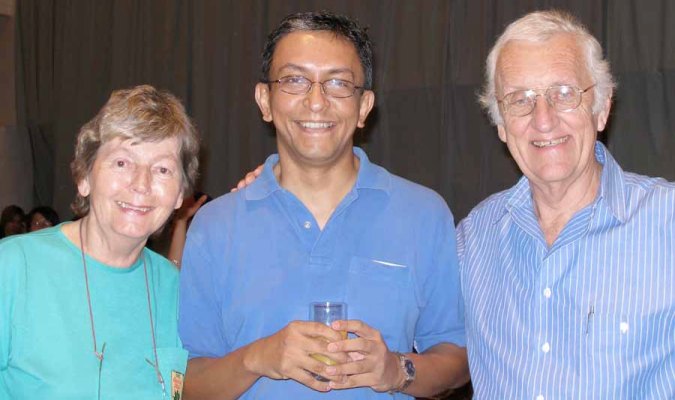
This photo was taken in August 2005 in Toyama, Japan, which is some 200km east of Tokyo. The occasion was during the Japan Wildlife Film Festival, held in Toyama every other summer since 1993.

I am seen with Brenda and Neil Curry, my film-maker friends from South Africa. That was a memorable night for Neil, whose remarkable film, The Elephant, the Emperor and the Butterfly Tree, won the festival’s highest award.

The 50-min film captures the delicate relationship between the elephant, the Emperor Moth and the Mopane Tree (scientific name: Colophospermum mopane). It was produced by Oxford Scientific Films for BBC Natural World, bringing together the creative talents of Neil Curry, Alastair and Mark MacEwen, and Sean Morris.

Here’s the full official synopsis of the film:
Mopane woodland has been symbolic of African bush for centuries but its ecology is often misunderstood. Its importance to the fragile ecosystem is paramount. In this programme we show the delicate relationship between the elephant, the emperor moth and the incredible mopane tree. We also show the vital impact this ecosystem has on a local family who depend upon the delicious harvest of mopane worms to supplement their diet, and the precious resources the mopane tree provides in order to survive in the mopane woodland of Botswana.

Foreign delegates, staff and volunteers of JWF2005 Neil Curry accepting the Best of JWF2005 award on behalf of his team

I was in Toyama as a guest speaker, talking about TVE Asia Pacific‘s Children of Tsunami media project, which was then in progress.

Brenda and Neil, originally from the UK, now live in wine country off Cape Town. Neil is the quintessential natural history film-maker: meticulous in his approach to a story, passionate in what he covers, and with tons of patience.

Most natural history film-makers go for animal subjects. It’s much harder to do an interesting film about a plant or tree that stays in one place and does not have an annual breeding cycle like animals.

That’s just one of many reasons why The Elephant, the Emperor and the Butterfly Tree is outstanding. It tells a complex story of an ecosystem that is inter-dependent and in balance.

The film, made in 2004, also won the top award at WildScreen (Bristol, UK), considered to be the oscar awards in wildlife and natural history film-making.

A stand of Mopane laden with seed pods - image courtesy Africa Hunter Image courtesy Tourism Botswana

Now here’s the rest of the story, which is not as upbeat. Neil spent many months in Botswana filming this story, and wanted to take the finished film back to the communities where it was shot. The wildlife parks and schools in the area, he knew, could make good use of the film to educate the local kids, adults and visitors.

What would be simpler than that? Get a VHS or DVD copy and pass it on to them, right?

Wrong. When I met Neil in the summer of 2005, it was more than 18 months since the film was made. For much of that time, he had been trying to obtain permission from the BBC to share a non-broadcast copy of his film with the people in Botswana. His request was passed from person to person, and from division to division, with no clear decision made, and no permission granted.

The BBC had invested funds in making the film, and had a legal right to decide how and where it was to be used. Focused on ‘revenue optimisation’ and ‘returns on investment’, its bean-counters could not care less whether the film-maker wished to share his creation with the local people whose reality he had captured.

This is not an isolated incident. In fact, it is alarmingly wide-spread: every year, excellent environmental documentaries and development films are produced, most of them using public funds (who pays the BBC license fee? The British public!). Yet these films are locked up in complex copyrights that prevent them from being used by anyone outside broadcast circles.

As I said in my recent speech to Asia Media Summit 2007:
Even where the film-makers or producers themselves are keen for their creations to be used beyond broadcasts, the copyright policies stand in the way. In large broadcast organisations, it is lawyers and accountants –- not journalists or producers -– who now seem to decide on what kind of content is produced, and how it is distributed under what restrictions.

I don’t know if Neil Curry ever cleared the rights to screen the film to small groups of people in Botswana or elsewhere in Africa. But I think of this every time BBC World cries its heart out for the poor and suffering in Africa.

This is one global broadcaster that does not put its money where its mouth is.

In fact, the BBC’s accountants must be laughing all the way to their bank.

Read my related posts: End this callous waste: Open up broadcast archives for combating poverty and ignorance!

Public funds, private rights: Big mismatch in development film-making

27 July 2007 – Neil Curry responds to my views on optimum duration of natural history documentaries

End this callous waste…open up broadcast archives for combating poverty and ignorance!

Image courtesy Boeing

This is the new Boeing 787 aircraft that was unveiled a few days ago — described as more fuel-efficient, and therefore more climate friendly. Not to mention being a more comfortable plane to fly on.

Now just imagine if one of these new aircraft were to be used for a single return flight — let’s say Singapore to London and back — and then relegating it to a hanger for the rest of its lifetime!

What a callous waste that would be. Now who would do that, and will that be tolerated?

Yet something like this happens in the moving images industry quite frequently….and not too many seem to be bothered.

Every year, many new TV films and documentaries are produced with considerable investment of time, effort and money. After one or few broadcasts, they are confined to broadcast archives. Trapped in copyright restrictions, they languish there even though they can be a vital resource for teachers, students, civil society groups and trainers worldwide.

To me, this is as much a criminal waste as throwing away a Jumbo jet after a single journey.

In fact, I’ve been writing and talking about it whenever I can. Here’s an extract from my speech to Asia Media Summit 2007 held in late May 2007 in Kuala Lumpur:

Every year, excellent TV programmes are made on different development topics. Public and private funds are spent in making these programmes, which draw in the creativity and hard work of committed professionals.

Many channels broadcast these programmes. They are typically aired a few times and then end up in the archives. Few may be exploited for their multimedia potential.

Yet many of these programmes have a longer shelf-life – and outside the broadcast sphere. They can be extremely useful in education, awareness raising, advocacy and training.

Alas, copyrights restrictions are often too tight for that to happen. Even where the film-makers or producers themselves are keen for their creations to be used beyond broadcasts, the copyright policies stand in the way. In large broadcast organisations, it is lawyers and accountants –- not journalists or producers -– who now seem to decide on what kind of content is produced, and how it is distributed under what restrictions.

Read the full text of my speech here

copy-of-copy-of-ams-ad2-low-res.jpg copy-of-copy-of-ams-ad2-low-res.jpg

This is why we at TVE Asia Pacific have been calling for poverty and development to be recognised as a copyrights-free zone. So that the crushing (and completely meaningless) grip of copyrights can be loosened up.

I first made this proposal in mid 2006, in an op ed essay published online at MediaChannel.org. I then reiterated it at the UN Headquarters in New York in September 2006, when addressing the 59th annual UN NGO Conference.

The idea has been well received in education and civil society circles. But predictably enough, the broadcast community itself has been less enthusiastic.

We just have to keep on at it.

Broadcasters united by Tsunami, but now divided again

In the broadcast industry, everybody knows each other — but then each one minds his or her own turf.

The United Nations, humanitarian agencies and advocacy groups have all tried to get media to co-operate more with each other, but these have remained largely token efforts.

Let’s face it: the broadcast media is fiercely competitive. TV networks and channels compete with each other in a given country or region. With channel proliferation there are more offerings chasing the same eyeballs.

But extraordinary situations bring out spontaneous collaboration in extraordinary ways. One such trigger is disasters.

Last December, speaking at a regional brainstorming on Communicating Disasters that TVE Asia Pacific organised with the UNDP, veteran Indian journalist A S Panneerselvan related a heart warming story of Indian broadcasters coming together on one such occasion.

The first hours and days after the Tsunami saw the highly competitive Indian news media organizations sharing each other’s information, visual and contacts in the true spirit of cooperation.

“Generally, the Indian news market is highly competitive with 18 TV news channels. They’re not willing to share visuals or co-operate. But something extraordinary happened soon after the Tsunami news broke. For the first time, none of the channels was insisting on exclusivity. They were simply downloading each other’s images, without even bothering about the rights or other issues.

“This was indeed rare. We know how many contracts have to be signed even for broadcasting 10 seconds of a cricket match. The kind of cross-flow of information after the Tsunami was amazing. All channel rivalries were momentarily forgotten.

“The only problem was with the international relief agencies, who are extremely hierarchy conscious. They were not easily available to the news media, and often they spoke only to influential Western news agencies such as Reuters and BBC.”

Panneer is now executive director of Panos South Asia. He was formerly the managing editor of Sun TV and bureau chief for Outlook magazine in India.

Read the full report of the Bangkok meeting on TVE Asia Pacific website

Public funds, private rights: Big mismatch in Development film making

After over a decade of extensive networking with environment, wildlife and development film-makers across the Asia Pacific, I have yet to come across a single film-maker who had a ‘sufficient’ budget to make their films or TV programmes.

All the film-makers I know — and that’s several dozen — wish they had a bigger budget to do a better film. At an individual professional’s level, that’s perfectly fine. But collectively, there just isn’t enough money to go around.

And to make matters worse, the number of film-makers keeps growing faster than how available funds expand. In fact, in real terms, the volume of funding to make development films has been shrinking. That’s another story.

In most parts of developing Asia, broadcasters don’t invest much — or any — funds in productions of development films. So independent film-makers, and sometimes even producers within TV stations, have to raise that money from elsewhere.

They turn to development donors, UN agencies, philanthropic foundations, corporate sponsors and even private individuals. They have to beg, borrow – but hopefully, not steal – to create content that is of public interest and educational value.

It’s a constant struggle, but when we get things right, the social benefits can be high.

But there’s one aspect in this whole endeavour that has not received sufficient attention for too long: what happens to the copyrights of such creations?

Development donors manage funds that have originally come from tax payers in industrialised countries — in other words, public funds. When public funds are invested in creating what are meant to be public goods, such goods must remain available and accessible without restriction.

But that’s where things often go wrong.

Public (donor) funds are used to finance the production of development films, yet neither their funders nor commissioners clarify the rights situation to ensure the widest possible public access to the film/s. An individual film-maker or production company takes advantage of this lack of clarity to appropriate the sole copyright, and starts restricting public access to the film/s by locking into exclusive arrangements.

The very purpose of investing public/donor funds in the film’s production is thus defeated.

I have seen this scenario repeat dozens of times across Asia and elsewhere. Usually it involves development donor officials or UN agencies whose media knowledge is rather limited, and whose commitment to the public domain is not always sincere.

It is a contradiction to have full control of copyrights vested in private individuals when films or TV programmes have been fully funded using public funds. To the best of my understand of the public interest, that is just not right.

This is why I keep raising it at every available opportunity. At Asia Media Summit in Kuala Lumpur yesterday, I touched on this in my speech during the panel on ‘mobilising airwaves against poverty’. I said:

522445368_8a10a4f2fa.jpg

I call upon development donors to insist that all development films and other media products they finance -– with tax-payer money – will have no copyright restrictions attached.

I hope the UN agencies will also take note. Perhaps inadvertently, they often get locked into exclusive rights arrangements with single production companies or broadcasters. This should be avoided.

I am proud to announce that all international TV content produced by TVE Asia Pacific is available to broadcast, civil society and educational users anywhere in the world without any license fees or copyright restrictions. We do practise what we preach.

And let us all consider alternative approaches to managing intellectual property — such as the Creative Commons framework now gaining acceptance.

In my virew, there are at least four possible options for handling the rights of a publicly-funded film or other media product:

1. Keep the rights entirely unrestricted (copyleft), allowing unlimited commercial and non-commercial uses of the work.

2. Share the rights equally between the film-maker and the party commissioning (and financing) the film, so that both parties may pursue distribution and promotion in ways they think fit, keeping each other informed if need be, but not having to seek each other’s permission for it.

3. Reserving all rights in the party commissioning (and financing) the film, leaving none of it to the film-maker.

4. Conceding all rights to the film-maker, allowing him/her the full discretion and choice on how rights are managed (or restricted). This is as good as sending the film into a ‘black hole’ from which it may never emerge again.

We don’t advocate option 3, because we respect the right of creative professionals to be acknowledged for their work, and to share the intellectual property (many UN agencies do this, and we don’t think that is healthy or warranted).

We have been applying option 2 in all content we commission from TVE Asia Pacific, and are now actively considering option 1 as well. This is because all our films are made using public (donor), foundation or corporate funds given to us in trust. That must be reflected in the rights regime we apply on the products.

And we never allow ourselves to get locked into a single broadcaster’s copyrights regime.

This is clearly a debate that must gain momentum.

Investing public funds to create privately-held copyrights is just not right.

Photo courtesy Justine Chew, GKPS

Asian broadcasters: Make poverty a copyrights free zone!

Today was the second day at Asia Media Summit 2007 in the Malaysian capital of Kuala Lumpur. Among the topics taken up today were gender, poverty reduction and climate change — all discussed from the perspective of broadcasters.

I was part of the plenary session on ‘Mobilising airwaves against poverty’ held this morning. Among the other speakers were Walter Fust, director general of Swiss Development and Cooperation agency (SDC) and Stephen King, Director of BBC World Service Trust.

As speakers, we were asked to address these among other questions: How can we generate in media real interest in development issues such as poverty? How can we secure more airtime in educating and bringing about better ways to fight poverty? How can media put the poorest of the poor at the center of attention?

panel-on-mobilising-airwaves-against-poverty-at-ams-2007.jpg

In my remarks, I called for an on-air/off-air combined ‘assault’ on poverty, ignorance, corruption and other scourges of our time. Powerful as they are, broadcasts alone cannot accomplish this massive task, I pointed out.

Here’s an extract from my remarks:

We all know the power of moving images. Used strategically, moving images can move people to change lifestyles, attitudes and behaviour.

Indeed, the right kind of information -– whether about microcredit, contraception, home gardening or immunisation — can vastly improve the quality of life, and even save lives that are needlessly lost.

But this is not something that one-off or even repeat broadcasts alone can accomplish. We need a mix of broadcast and narrowcast approaches.

Communicating for social change is a slow, incremental process that involves learning, understanding, participation and sharing.

At TVE Asia Pacific, we work equally with broadcast, educational and civil society users of moving images. Our experience for over a decade shows that narrowcast work can reinforce and build on the initial broadcast outreach.

But that’s easier said than done. Every year, excellent TV programmes are made on different development topics. Public and private funds are spent in making these programmes, which draw in the creativity and hard work of committed professionals. Many TV channels willingly broadcast these programmes. After a few transmissions, these end up in broadcast archives. A few are adapted for multimedia use. That’s the nature of this industry.

Yet, as I pointed out, most of these programmes have a longer shelf-life. They can be extremely useful in education, awareness raising, advocacy and training. But unfortunately, copyrights restrictions are often too tight for that to happen. Even when the film-makers and producers themselves are keen for their creations to be used beyond broadcasts, the copyright restrictions stand in the way.

I said: “Broadcasters need to let go of development related TV content after initial broadcasts. They must also allow educational and civil society users greater access to vast visual archives, gathered from all over the world.”

I then repeated a proposal I first made last year, which I have since presented at the UN Headquarters and other forums: make poverty a ‘copyrights free zone’.

The idea is to have broadcasters and other electronic publishers release copyrights on TV, video and online content relating to poverty and development issues -– at least until (MDG target year of) 2015.

Read my original essay on poverty as a copyrights free zone, published in June 2006

There was a mixed reaction from the predominantly broadcast audience. I knew it wasn’t going to be an easy sell: this industry is so closely tied to copyrights and licensing in not just commercial but also emotional terms. Letting go of these rights, even in a limited way for a highly worthy cause, is a quantum leap for broadcast managers raised on strict rights regimes.

More about the reaction in a later post.

Meanwhile, here’s the full text of my remarks:

nalaka-gunawardene-speech-to-ams-2007-final.pdf

Photo courtesy Manori Wijesekera, TVEAP

Copyright, copyleft and film-makers in the digital age

In my post on 1 April, Have you made your million dollars yet?, I wrote:

Many development film-makers like to decry our society’s obsession with money, consumerism and greed. Some would make films that passionately promote sharing ideas and resources at community level, and advocate common property resources over private ownership.

But when it comes to rights of their own film/s, these very film-makers would become extremely possessive: they want to restrict it in every conceivable way.

This came up during a session at the OUR Media 6 conference in Sydney yesterday.

Andrew Lowenthal, from EngageMedia in Australia, talked on ‘Online video for social action’ and presented what his non-profit organisation is doing.

As their website says:
EngageMedia is a website and a network for distributing social justice and environmental video from South East Asia, Australia and the Pacific. It is a space for critical documentary, fiction, artistic and experimental works that challenge the one-way communication model of the mainstream media.

Andrew said they currently host around 120 videos online, all offered for free public access at the moment. They are keen to add more titles to this collection, to build an online, engaged community of film makers and film viewers.

But as we discussed, many film makers aren’t yet ready or willing to give their films to be placed online.

“Some of them freak out at the very mention of being placed online. They ask how their copyright can be safeguarded, and how they can make money,” Andrew noted.

Fred Noronha, who has campaigned for a long time for Indian documentary makers to open up and share their films, agreed. “Many film-makers are apprehensive. They aren’t broadcasting, or webcasting their productions. They just show it at a few film festivals. Many films don’t go out to the wider public.”

At TVE Asia Pacific, we come across this all the time. As a non-commercial, non-exclusive distributor, we ask film-makers to share distribution rights while copyright stays firmly with them. Even then, many are not convinced.

Of course, each creative professional is entitled to the full returns of their investment of time, effort and creativity. But let’s not forget: many films, especially those on development issues (which covers health, education, environment, ICT, science in development and human rights, among others), are made with development funding or philanthropic grants. Which means the production costs are largely or entirely paid for.

Yet when such films are made, their creators would rather hang on to them than let them go. Copyright is one concern they cite. ‘Returns on investment’ is another. (Hmmm…if a film has been paid for by public/donor funds, returns to whom?)

Creative Commons offers a good way forward, and we had a presentation from CC Australia on this during the session. More about that later.

Go to:
Engage Media
Creative Commons