On 30 March 2007, I was part of a South Asian Workshop to pre-test a pilot e-module on Science Journalism. Held at the University of Hyderabad, India, it brought together a small group sharing a passion for science journalism and science communication. It was organised by SciDev.Net with support from UNESCO.
I used my remarks to pay tribute to an important and lasting influence on my own career as a development communicator: Our Common Future, report of the Brundtland Commission that came out exactly 20 years ago. The anniversary was marked by a few organisations like IIED, but I felt it deserved better observance.
Here’s an extract from my remarks:
Within a few months of my entering active journalism, something happened globally that left a deep impression on me -– and as I later found out, on many others like myself in different parts of the world. In March 1987, the World Commission on Environment and Development –- chaired by the then Norwegian Prime Minister Gro Harlem Brundtland -– published its final report. Titled Our Common Future, it was the first of its kind to draw broad links between environmental, social and economic concerns and it made international policy recommendations accordingly. It prompted the UN to convene the Earth Summit in Rio de Janeiro in 1992.
The Report didn’t invent the concept or term sustainable development, but it certainly helped popularise it. The Commission’s work helped the environmental movement to evolve from the tree-hugging, whale-saving, cuddly animal level to a higher and multi-faceted level of environmental management.
And it inspired a generation of young journalists, educators and activists worldwide. I count myself among them –- in that sense, we are all Children of Brundtland.
My personal tribute to Theeban has been widely circulated online. Edited versions have appeared on MediaHelpingMedia (UK) and Asia Media from University of California Los Angeles (USA).
It appears that my tribute has moved many readers. I’ve heard from several by email – encouragingly, all supportive and sympathetic. Among those who wrote was young journalist Chathuri Dissanayake, who worked as a researcher for Video Image, the Sri Lankan production company we (TVE Asia Pacific) engaged to film Theeban’s unfolding story for most of 2005.
With her permission, I want to share her recollections and views:
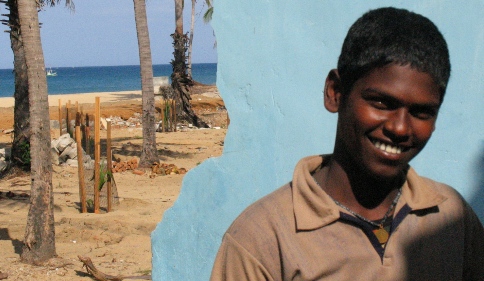
It’s a very nice piece about Theeban. It captures what we had grown to love in the boy. The picture you have of him taken on I think our first visit brings back a lot of memories.
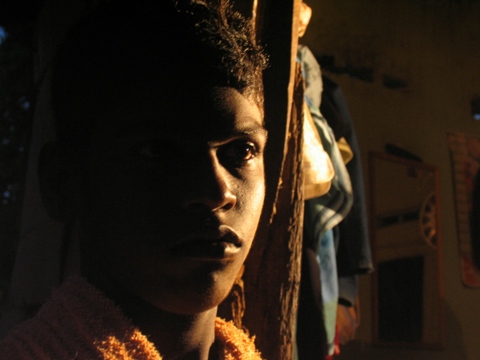
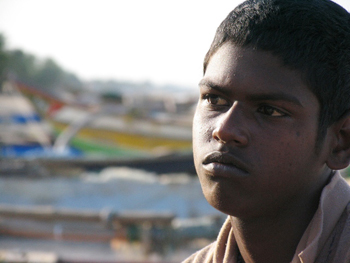
When he was abducted (in late 2006), I always thought at least he is alive, now I’m still trying to come to terms with the fact that he is no more. The best memory I have of him is his wide smile. The pictures you have chosen bears ample testimony as to how beautiful that is. Even though he couldn’t communicate with us coz of the language barrier his smile and eyes were so expressive. When I first met him at the camp what struck me most was his unspoilt innocence. I wish I had taken a bit more trouble to help him out after the filming ended.
Theeban gave life to harsh realities of the conflict in the country that I have lived all my life with. Before meeting Theeban and visiting his village, I only knew what media told me of the east but Theeban brought it closer to me. Earlier, when ever I heard of the violence in the north or the east, it was just news to me as it was to many living in the “right side of the country”. But the Children of Tsunami project opened up the other side of the story, and as a young journalist, I gained a lot of experience.
To me, Theeban was real and he represented many youngsters in the area. His scattered dreams and hopes were real and it is a tragedy that help doesn’t reach them. Nothing substantial was done to help him and many others like him to rebuild their lives. Theeban was too young for any sort of vocational training that was available, and he didn’t have the right qualifications. My dilemma of what would happen to Theeban and many like him whose futures were washed away in the Tsunami grew as all the options of vocational training I checked out for Theeban turned out that applicants needed at least (GCE) Ordinary Level. Theeban was forced to leave school and it looked as if it never struck to any authority that someone needs to look after the youths like Theeban.
To me Theeban, like many others was another victim of forces that he had no control over. It was not his fault that a tidal wave destroyed his family but he paid for it dearly, gave up his education and took the responsibilities of the bread winner of the family on to his shoulders. When the Tsunami struck he was still hopeful he wanted to earn money and take care of his brothers. He missed his mother dearly but found a bit of comfort in his grandma. But the violence that sprang up in the area had no mercy on him. Theeban’s story ended in tragedy coz the forces that were against him were too strong for him to fight back. The hope I saw in his eyes still haunts me. But I take comfort in knowing that at least he tried to fight back. No matter what his shy smile and shining eyes will remain with me.
That is how I remember Theban best. A youth who managed to smile and have a hope for the future in spite of the trauma that he went through when many grown up men around him gave up on life.
Nan Nan is a young girl living in Guo Zhuang Village, in China’s Anhui province. Her parents died of AIDS sometime ago, and she now lives with an older sister — and HIV.
After her parents’ death, the two girls were shunned by relatives and left to live without adult care. “Little Flower,” Nan Nan’s teenage sister, is about to get married. She vows not to tell the groom about her sibling’s disease.
Nan Nan is one China’s estimated 75,000 (and growing) AIDS orphans. She is one of several children whose depressing story is captured in a documentary film, The Blood of the Yingzhou District (China/USA, 40 mins, 2006).
I watched this film last afternoon at the Woodrow Wilson Centre in Washington DC as part of the DC Environmental Film Festival. For me, it was one of the highlights of the festival. After all, this film won the Oscar award for Best Documentary, Short Subjects (while Al Gore’s An Inconvenient Truth won the Oscar for best documentary feature).
Notwithstanding the giggly woman moderator provided by the host institution, and even in the absence of any representative from the film’s producers – China AIDS Media Project — the audience managed to have fairly good discussion with a representative from Family Health International who was panelist to discuss the issue of AIDS orphans.
Accoring to FHI, some 15 million children worldwide have lost one or both parents to HIV/AIDS — and the numbers continue to grow as the pandemic consumes men and women of child-bearing age.
But the millions and billions don’t make much sense to most people. It’s hard to visualise more than a few thousand, let alone millions. This is something that UN agencies – all claiming to be serving the poor and disadvantaged – often forget: they dabble in the abstract, theoretical and statistical matters far removed from real people, real issues.
This is just what we tried to do in our own Children of Tsunami media project, in which producing a documentary film was one of many outputs across different media platforms and formats.
A question was asked how the film has been received in China. The giggly moderator informed us that it is allowed to be screened in China, which is encouraging. But the Chinese response to the film has been mixed, as can be expected. See this interesting exchange online.
What impressed me the most was the film’s subtle yet powerful use of soundtrack – a good mix of music, natural sounds and spoken voices. Some featured children did seem a bit like acting at times, but that didn’t detract the film’s value too much, at least for me.
Thillainayagam Theeban (1990 – 2007)Since we started Children of Tsunami media project in early 2005, as a citizen media response to the Indian Ocean Tsunami, I have introduced it to dozens of audiences of many and varied kinds in different parts of the world. But presenting our documentary, Children of Tsunami: The Journey Continuesto the 15th DC Environmental Film Festival at the World Bank headquarters yesterday (16 March 2007) was perhaps the most difficult of all.
No, this was not a cynical audience – far from it, they turned out to be a very appreciative one, as I describe in my other post. But this was the first public introduction I had to make after we lost Theeban, the Sri Lankan boy who was one of eight children whose recovery story we tracked and filmed for much of 2005.
Theeban was murdered by unidentified gunmen who stormed into his ‘temporary’ tsunami shelter on 3 March 2007. The death is linked to spiralling political violence that is once again sweeping across Sri Lanka.
When the shocking news reached us three days later, our Sri Lankan camera team at Video Image and we at TVE Asia Pacific just couldn’t believe it. We were all in tears, and some of us were also angry. Theeban, who survived the killer waves 26 months ago (but lost his mom and kid brother in the disaster) suffered many indignities in displacement. And now, he is gone.
It’s now two weeks since Theeban was killed, but I still can’t speak about it without a lump in my throat.
That’s why I was nervous in introducing the film yesterday at the festival: I knew I was just seconds away from being stuck for words, and overcome with emotion.
My friends in the audience later said I had managed reasonably well. This is what I said as I ended my brief introduction:
“We ran out of funds to sustain our monthly filming beyond end 2005. By then we found that our film crews and we ourselves had become attached to our participating families, and especially the children who worked so closely with our film crews. We remain interested in their personal progress, even if we can no longer publish their stories.
Earlier this month, we received the devastatingly sad news that the Sri Lankan boy we filmed has been murdered –- by unidentified gunmen, right at the ‘temporary’ camp in Eastern Sri Lanka.
Thillainayagam Theeban survived the killer Tsunami waves and endured 26 months of extreme hardship in displacement — only to be swept away by the wave of political violence currently sweeping Sri Lanka.
We still don’t know who killed Theeban, and for what reasons. He was abducted by an armed group a few months ago, from whom he escaped earlier this year. It is believed that Theeban was killed as a punishment — and as a warning to all others.
He was 16 years at the time of his death. We don’t know if his killers would ever face justice.
I want to dedicate this screening to Theeban — and thousands of young people like him who are still languishing in temporary shelters, struggling to rebuild their futures.”
After the screening, there was some sympathy and empathy in the audience about Theeban. But on the whole this particular development didn’t inspire too many questions or remarks. The predominantly American audience seemed more intrigued by our journalistic documentation of how evangelical Christian groups rushed to tsunami-struck Asia, offering relief support coupled with religious conversion. (Find out more about this by watching the film online.)
Ah well, everyone takes away something different from a film like Children of Tsunami. It has so many facets and elements mixed together.
We set out asking lots of questions, and found only a few answers. We still have lots of questions in search of answers…and new ones emerging.
This was part of the 15th Environmental Film Festival in the Nation’s Capital, held at multiple venues showcasing a total of 115 films from all over the world. Good friends at the World Bank had recommended and sponsored the screening of our film.
Despite rains lashing the US capital and in the freezing cold, close to 80 people turned up to see the film, which was very encouraging. The compact auditorium was virtually full, and practically everyone stayed for the entire one and a half hour event. At the end, many of them made supportive remarks or asked good questions. It was very gratifying to present our work to such an appreciative audience.
Introducing the film, I said:
“Children of Tsunami is different from most other films in this festival. It’s not an environment film, nor is it a wildlife film.Yet it’s all about wild…life!
This film is about the aftermath of a mega-disaster, when life itself went wild, shattering the futures of hundreds of thousands of people across South and
Southeast Asia.
The Asian Tsunami of December 2004 triggered one of the biggest humanitarian relief efforts in history. It also inspired an unprecedented volume of donations and aid to the affected countries and people.
Our film begins when the media frenzy had begun to die down. We take over after most news cameras left the scene.
Indeed, Children of Tsunami started out in some anger and frustration. We were deeply concerned that most news media coverage focused on death and destruction, or doom and gloom. For sure, it was a large scale tragedy, but there were stories of courage and resilience, which we felt didn’t get the coverage they deserved.
In most post-tsunami media coverage, the affected people were portrayed as ‘victims’ rather than survivors. They were also reduced to nameless, faceless statistics. Whole countries or regions were reduced to simple blips on a map.
And then, after a few days and weeks of saturation coverage, the news media started to move on to other breaking stories. That’s the nature of our media.
But we who live and work in Asia knew the story was far from over. We knew the recovery stories would unfold for months and years to come. We wanted to keep these stories alive. We were keen to stay and move with the stories.
So in mid January 2005, we started the Children of Tsunami media project….”






 Open Minds!