Laugh, and the world laughs with you; Weep, and you weep alone…

I cry, therefore I am
“If you have tears, prepare to shed them now,” urged Mark Antony to fellow Romans after Julius Caesar died.

But what if you simply don’t have any tears to shed? That’s what my eye doctor recently cautioned me, after a routine examination. The natural tearing in my eye, necessary for keeping it moist and clean, wasn’t quite working. There is nothing to worry, he hastened to add, for it sometimes happens as our bodies slowly age. He asked me to use eye drops twice a day for a while.

This set me thinking about the value and power of tears. Although most land mammals have a lacrimation system to keep their eyes moist, humans are the only mammal generally accepted to cry emotional tears.

In my circles, I’m known to be an emotional guy. I have never believed in that macho myth of men not crying. I shed tears of joy and tears of sorrow, sometimes in public. I cry when people I know, admire or love leave this world, sometimes at the most unexpected moments. Powerful movie moments of triumph or despair often move me to tears, as do simple joys of life — such as seeing my kid perform well on stage in a school concert.

Despite what my doctor says, I’ve been shedding plenty of tears this year.

I openly wept when journalist colleague Lasantha Wickrematunge was gunned down in broad daylight on a cruel January day. He was Sri Lanka’s real leader of the opposition.

My eyes were completely misty when the news of the original TV news anchorman and broadcast giant Walter Cronkite passed away on 18 July 2009 after an illustrious career spanning decades.
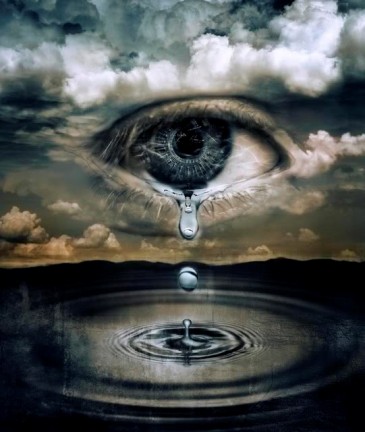
Have tears, will shed...
Two weeks later, I joined millions of Filipinos in mourning the passage of Cory Aquino, the courageous woman who led the world’s first People Power revolution, toppling one of the worst tyrants of the 20th century.

In contrast, Michael Jackson’s death on 25 June didn’t immediately move me to tears, even though I quickly wrote a tribute. But the live broadcast of his star-studded funeral service on 6 July did. I watched it in the solitude of a hotel room in Amsterdam on a warm summer evening, and cried — as much for the tragic end of the man as what he stood for. Those tears inspired the op ed essay on the two Moonwalks.

I can add more to this list if I think long enough. The point is: my eye specialist’s clinical examination didn’t capture these highlights (lowlights?). There’s a part of our emotional lives that our doctors may never fathom. We ourselves are often barely aware of it.

A recent article in Reader’s Digest (March 2009 issue), titled Big Boys Don’t Cry — and Other Myths About Men and Their Emotions, said new research reveals that a man’s emotional life is as complex and rich as a woman’s, but often remains a mystery to him as well as to any woman who loves him. You can say that again!

Conventional wisdom doesn’t encourage or celebrate grown men crying. One of my favourite poems is ‘Solitude’ by Ella Wheeler Wilcox, which opens with these memorable lines:

“Laugh, and the world laughs with you;
Weep, and you weep alone;
For the sad old earth must borrow its mirth,
But has trouble enough of its own.
Sing, and the hills will answer;
Sigh, it is lost on the air;
The echoes bound to a joyful sound,
But shrink from voicing care.”

My close friends think I’m melancholic by nature, and long ago I came to terms with who and what I am. I don’t spend my days lamenting or weeping, for sure, but I also don’t hesitate to cry when the emotion warrants it.

If that means I weep alone, so be it.
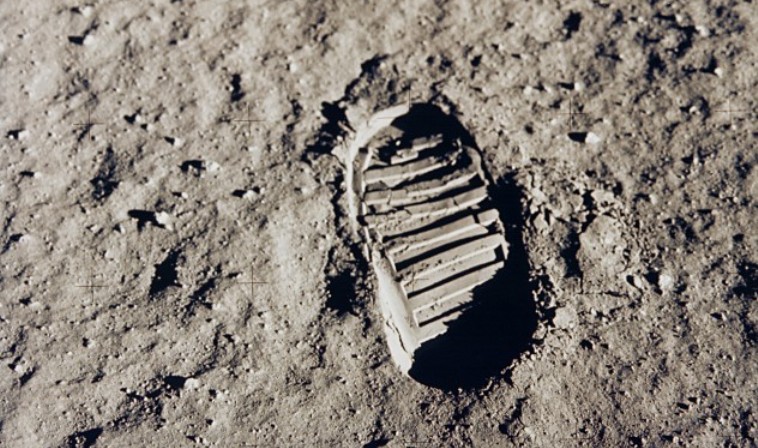
One small step for (a) man, one giant memory for…me!

This can outlast us all...
The most expensively obtained footprint in history, this can outlast us all on the airless Moon...

When Neil Armstrong took that first ‘small step’ on to the Moon, at 10.56 pm Eastern Standard Time on 20 July 1969, it was already 21 July in many other parts of the world. It didn’t matter: day or night, East or West, people all over followed the mission’s progress over TV or radio. As Armstrong climbed down the lunar module’s ladder, more than 750 million people back on Earth had collectively held their breath.

This event holds special significance for me personally. It’s the earliest childhood memory that I have which can be pinned down to a specific date. And what a date!

I was a little over three years old at the time (as I like to put it, I’m the same age as Star Trek!). The year 1969 was already the most eventful yet in my (very short) life: in April that year, a younger sister was born. And at the beginning of July, I started in pre-school. I should think that at least the ‘headlines’ of such key events would be imprinted in my (usually good and sharp) memory. But those events are buried deep beneath the sediments of memory, and I have to turn to secondary (parental) sources to get any details.

What I do remember, to this day, is the excitement over the first Moon landing. My father was listening to the live radio broadcast on Voice of America. Sri Lanka had no television broadcasts then (that medium would arrive only 10 years later), so the only choice was to tune in to radio and imagine the pictures….or wait for the next day’s newspapers.

The crackling shortwave transmission came in loud and (mostly) clear through the large radiogram that sat in a prominent corner of our spacious living room. At over three feet in height, and encased in neatly polished wood, the instrument must have appeared formidable to little me. That was our solitary window to the outside world.

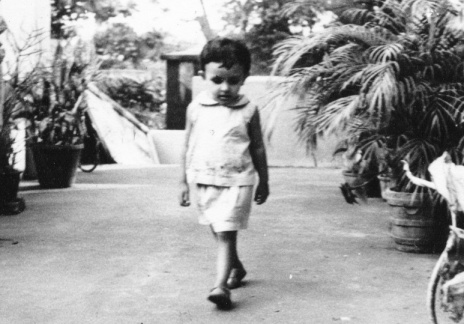
One of my earliest childhood photos...not longer after I took my own first 'small steps'
One of my earliest childhood photos, circa late 1968...not long after I took my own first 'small steps'
Although I realised something pretty important was happening, I didn’t understand what the commentary said. English was still an alien language – heck, at that tender age, I was still picking my mother tongue! But the inquisitive brat that I was, I asked my father to give me occasional summaries of what was going on. His school teacher experience must have helped him to distill the essence for me.

After all these years, I can’t remember too many details. But the highlights linger on, if only as distant headlines. Neil Armstrong’s one small step was taken. Neil and Buzz hopped around like kangaroos, enjoying the lower lunar gravity. They planted the American flag and set up scientific instruments. Then collected lunar soil samples. They often talked as they worked. Mission Control closely followed their every move…as did the whole world, a quarter of a million miles away.

Then it was time to head back. I would later find out that leaving the Moon after two and a half hours of exploration was a particularly tensed moment in the mission. The astronauts had one chance to rejoin the ‘mother ship’ orbiting the Moon. If their lunar module failed to take off, they’d be marooned on the Moon — with absolutely no hope of a rescue.

Having spent just about 1,000 days on Earth myself, I had no clue about any of these dangers. But the one ‘tough’ question I still remember asking my father is: “What could happen if the astronauts can’t return?”

I’m not sure what answer, if any, he gave me. His background was in history and languages, not science. But that sure was an indication that I had the knack for asking difficult, sometimes irritating, questions.

Forty years on, I still haven’t stopped.

Popular Mechanics July 2009 issue has some soundbites from the VOA’s Apollo 11 broadcast