Text of my ‘When Worlds Collide’ column published in Ceylon Today Sunday newspaper on 12 August 2012
Ran Muthu Duwa (Island of Treasures), the first colour Sinhala feature film made in Sri Lanka, was released exactly 50 years ago this week, on 10 August 1962.
Ran Muthu Duwa was a trail-blazer in the Lankan cinema industry in many respects. It not only introduced colour to our movies, but also showed for the first time the underwater wonders of the seas around the island.
It was different from many formulaic Sinhala films made since 1947, and included elements of underwater treasure, ancient legends, human treachery and, predictably, some romance. It may not have been great art but was a box office hit. An estimated one million people saw it during the first release: a tenth of the island’s then population.
But the cultural influence of the film went well beyond…
Text of my ‘When Worlds Collide’ column published in Ceylon Today Sunday newspaper on 5 August 2012
“All the world is a quiz, and all the men and women merely players.”
That’s how the late Magnús Magnússon, host of BBC television’s long-running quiz Mastermind, once summed up his line of work. He believed that everything in the world was matter for a quiz. As a quizmaster for over two decades, I heartily agree!
Quizzing, also known as general knowledge (GK), is an established mind sport where players engage in a friendly tussle using quick wits and sharp memories. In recent years, it has evolved its own world body and global rankings.
The origins of quizzing go back to ‘pub quizzes’ – the impromptu testing of trivial (mostly sporting) knowledge over a drink in that quintessentially British setting for socialising. Bar tenders often had to arbitrate…
Quizmaster Nalaka Gunawardene smiles — is it because he knows ALL the answers? Photo by Dhara Gunawardene
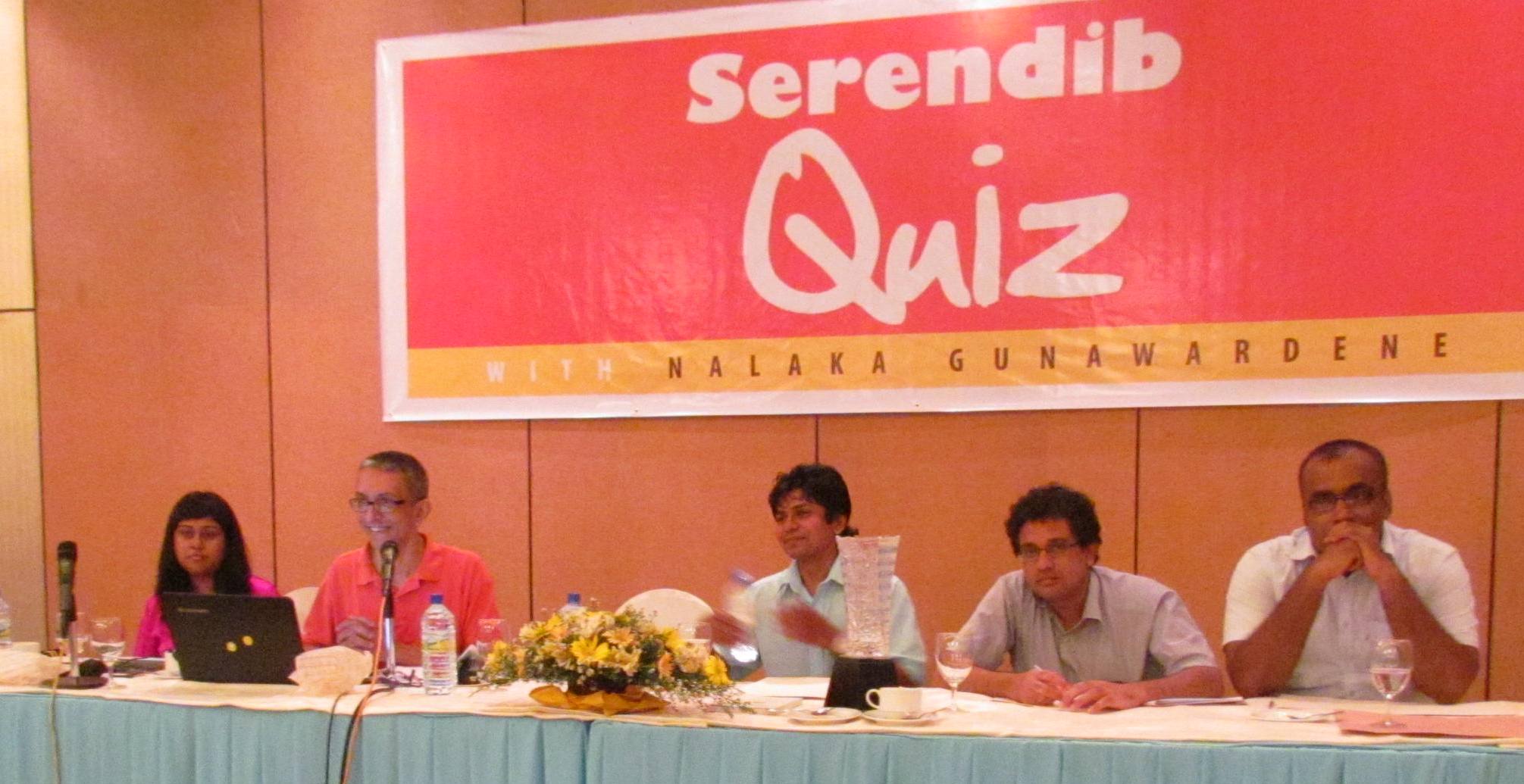
I just finished hosting the first edition of Serendib Quiz, a new live quizzing event in Sri Lanka.
Here’s a short promo text we produced just after the event:
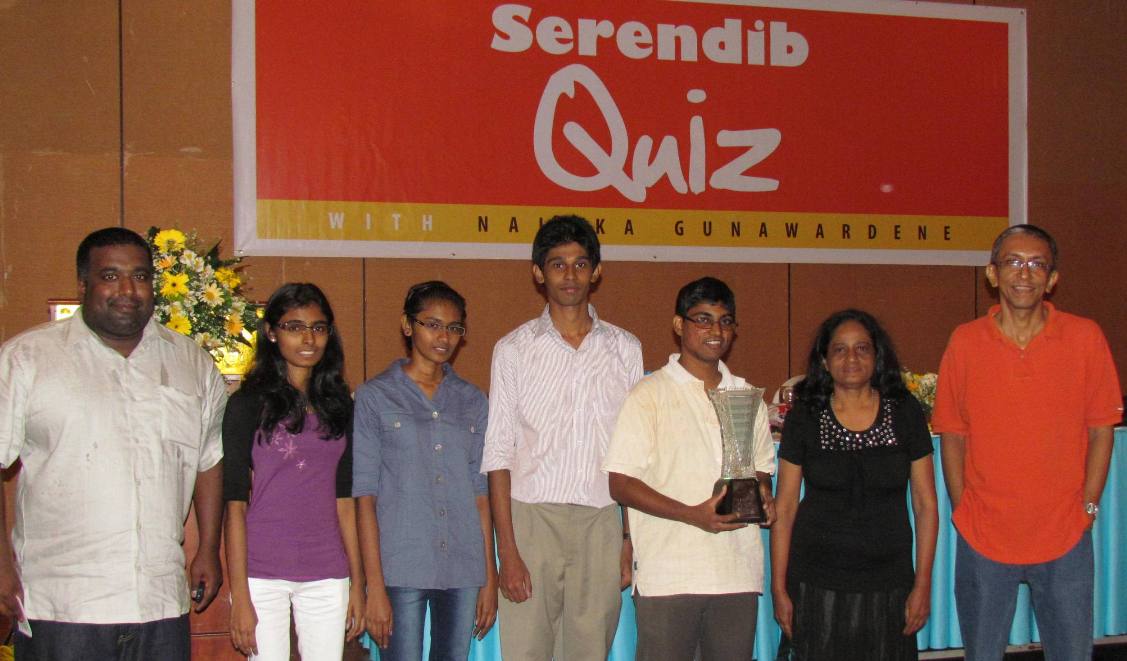
A team of private individuals, called the ‘Invictus Team’, emerged overall winners at the inaugural Serendib Quiz held at the Galadari Hotel, Colombo, on 29 July 2012.
Invictus beat 40 other teams from all over Sri Lanka to win the top prize of Rs. 100,000 and the specially designed Serendib Quiz glass trophy.
Two other individual teams – Chamara Sumanapala’s Team and Imran Furkan’s Team – secured second and third places respectively.
A total of 205 players, in 41 teams, took part in this live quizzing event compiled and hosted by Nalaka Gunawardene, a leading quizzing professional. Participants’ ages ranged from 13 to 65 years. Many teams came from schools, banks and private companies while a number of quiz enthusiasts competed as private teams.
The team representing Dharmaraja College, Kandy, was the winner in the educational category, followed by Ananda College and the Royal College A Team. All members of these teams received British Council Library gold memberships, in addition to book vouchers and books.
Srilankan Airlines came first in the corporate category, while Seylan Bank was the winner in among banks and financial institutions.
Serendib Quiz was organised by Quiz World (Pvt) Limited and sponsored by Commercial Credit PLC in partnership with Sarasavi Bookshop (Pvt) Limited, Fast Ads (Pvt) Limited, the British Council, BT Options, TVE Asia Pacific and Kent Holdings.
Serendib Quiz involved 50 questions from all areas of knowledge, local and global, presented in five rounds. Contestants worked simultaneously in teams to write out answers that were immediately marked by a three-member judging panel.
Text of my ‘When Worlds Collide’ column published in Ceylon Today Sunday newspaper on 29 July 2012
By the time you read this, London Olympics 2012 would have started with an opening ceremony showcasing the best of Britain. Themed as ‘Isles of Wonder’, it was put together under the overall direction of Oscar award winning British filmmaker Danny Boyle (who directed Slumdog Millionaire).
Four years ago, the Chinese film director, producer and writer Zhang Yimou was in charge of the opening and closing ceremonies of the Beijing Olympics.
Such mixing of sports and show biz is an indicator of how much is at stake. Every host city tries to outdo previous ones in staging an event that combines sportsmanship, performing arts and visual wizardry.
Those spectators who pay top-Dollar (or Pound) prices for stadium tickets are only a small part of the intended audience. Thanks to the vast outreach…
Text of my ‘When Worlds Collide’ column published in Ceylon Today Sunday newspaper on 22 July 2012
This week, London welcomes the world’s Olympians once again as it becomes the first city to host the modern Olympics thrice.
Even for a global city like London, with well developed infrastructure, coping with the influx is quite a logistical challenge. So its city authorities have been urging more people to avoid coming to town. In fact, Transport for London has been running a campaign to get a third of commuters to work from home during the Games.
Text of my ‘When Worlds Collide’ column published in Ceylon Today Sunday newspaper on 15 July 2012
My column last week – about World Health Organisation confirming diesel fumes cause lung causer – elicited many responses. Some cautioned that phasing out high sulphur diesel from Lankan roads isn’t going to be easy.
The automobile industry has much at stake and would want to continue business as usual. Policy, legal and regulatory changes take time, and will require evidence-based arguments and sustained pressure. Health campaigners and environmentalists have their work cut out for them.
They must stay focused on vehicle emissions. Yes, some power plants are also prolific users of diesel, but they have smoke stacks and their emissions can be centrally treated. In contrast, millions of diesel-burning vehicles are a distributed — and mobile — source that emits fumes right in our faces.
Text of my ‘When Worlds Collide’ column published in Ceylon Today Sunday newspaper on 8 July 2012
Sometimes well-meaning yet ill-informed environmentalists can be their own worst enemy. By barking up the wrong tree, they distort public sentiments and even affect policy responses.
Take air pollution in Sri Lanka, for example. For decades, the greens have vilified factories as the principal source. In reality, over 60% of outdoor air pollution is now caused by vehicle emissions.
Over a decade ago, when I first wrote about diesel fumes being potentially cancer-causing, some greens urged me not to take on ‘the poor man’s fuel’. On a similar reasoning, successive governments have subsidised diesel prices to the tune of billions.
Text of my ‘When Worlds Collide’ column published in Ceylon Today Sunday newspaper on 1 July 2012
There is a best-selling little book titled Everything Men Know About Women. Written by Cindy Cashman (under the pseudonym of Dr Alan Francis), it has been in print for over two decades and contains a ‘profound message in its simplest form’: every page is completely blank.
My women friends claim this is the bare truth, but let’s not argue that here. I think of this book — I was once gifted a copy! – whenever I listen to environmental scientists say how little we still know about our home planet.
At the recent Rio+20 summit and in the weeks leading to it, many experts reminded us of the limits of our scientific understanding of the intricate and inter-linked natural systems on Earth. We know even less about how 7 billion of us…
Text of my ‘When Worlds Collide’ column published in Ceylon Today Sunday newspaper on 24 June 2012
As government officials, activists, researchers and journalists from around the world converged in Rio de Janeiro this week for the UN Conference on Sustainable Development, everyone was clamouring for answers, solutions and agreements.
For journalists, at least, there was no shortage of stories – if only we went off the beaten track.
I wanted to see real city beyond the tourist hype and summit frenzy. So, as the heads of state sat down for their talkfest at the Rio Centro convention centre, I walked the streets of downtown Rio.
The city had declared three days of holiday, life went on as usual. Planet saviours were in town, but the…
Text of my ‘When Worlds Collide’ column published in Ceylon Today Sunday newspaper on 17 June 2012
I have a confession to make: I was once an environmental journalist.
With all good intentions, I thought I could help save the planet through my reporting, analysis and opinion writing in the media. I spent several years of my youth sincerely, passionately chasing stories about environmental problems – and solutions.
Luckily for me, and my readers, I realised my mistake after a while. I’ve been striving to see – and show – the bigger picture ever since.
As the UN Conference on Sustainable Development culminates in Rio de Janeiro, Brazil, in the coming week, it is a good time to reflect how we got here, and what happens next. The collective journey thus far has considerably shaped my own career – even though I didn’t always follow the pack…



 Open Minds!