One Planet’s Climate Challenge on BBC World

Climate Challenge is a new, weekly, 6-part series coproduced by our Geneva-based partner
dev.tv and UK partner, One Planet Pictures. It begins broadcasting on BBC World from Wednesday, 4 April 2007.

The series goes local and global to find here-and-now answers to climate change. It makes the point: in the fight against global warming, developed and developing countries must work hand-in-hand to find viable solutions for all.
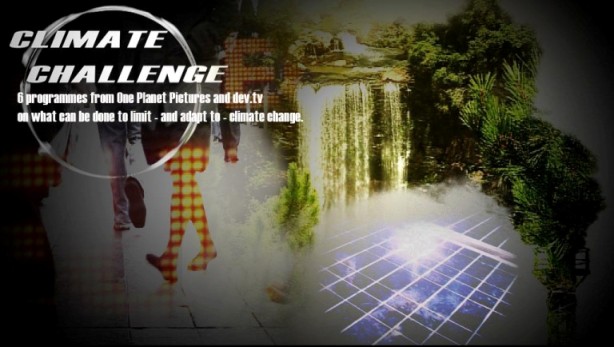
climate-challenge.jpg

Here’s the blurb from One Planet Pictures website:

So it’s official. Even President Bush in his latest State of the Union Report has acknowledged that global warming is happening. The scientists of the UN’s Intergovernmental Panel on Climate Change say that only swingeing cuts in the release of greenhouse gases can save our planet from becoming a Venusian hothouse.

But how can that be achieved when even the modest Kyoto targets are not being met by most rich countries? And when the world’s most populous countries are expanding their energy requirements at an unprecedented rate? What can be done to head off a catastrophe?

In Climate Challenge, One Planet Pictures’ film-makers focus on some of the most promising approaches to turning down the global thermostat. Climate Challenge goes local and global in search for solutions that won’t put a break on economic growth

The series will be distributed by TVE Asia Pacific after its initial run on BBC World.

For broadcast times, see dev.tv website or checkout BBC World programme schedule

BBC World is the commercially-operated international broadcasting arm of the BBC.

The ‘Children of Brundtland’, 20 years on

On 30 March 2007, I was part of a South Asian Workshop to pre-test a pilot e-module on Science Journalism. Held at the University of Hyderabad, India, it brought together a small group sharing a passion for science journalism and science communication. It was organised by SciDev.Net with support from UNESCO.

I used my remarks to pay tribute to an important and lasting influence on my own career as a development communicator: Our Common Future, report of the Brundtland Commission that came out exactly 20 years ago. The anniversary was marked by a few organisations like IIED, but I felt it deserved better observance.


Here’s an extract from my remarks:

Within a few months of my entering active journalism, something happened globally that left a deep impression on me -– and as I later found out, on many others like myself in different parts of the world. In March 1987, the World Commission on Environment and Development –- chaired by the then Norwegian Prime Minister Gro Harlem Brundtland -– published its final report. Titled Our Common Future, it was the first of its kind to draw broad links between environmental, social and economic concerns and it made international policy recommendations accordingly. It prompted the UN to convene the Earth Summit in Rio de Janeiro in 1992.

The Report didn’t invent the concept or term sustainable development, but it certainly helped popularise it. The Commission’s work helped the environmental movement to evolve from the tree-hugging, whale-saving, cuddly animal level to a higher and multi-faceted level of environmental management.

And it inspired a generation of young journalists, educators and activists worldwide. I count myself among them –- in that sense, we are all Children of Brundtland.

IIED London takes stock of 20 years after Brundtland Commission Report