Enriching South Asian airwaves: Ujala TV is one year and counting…

Some of us dream about doing great things. Other agitate for reform. A few among us just go ahead and do it.

This story is about one such group, and its inspirational leader, who took on the formidable challenge of setting up an educational television channel for South Asia.

Just thinking about it can scare away most people. Home to over 1.5 billion people, including the largest concentration of poor anywhere in the world, South Asia is in a region full of disparities, divisions and desperation. It is not only the most militarised region in the world, but also one of the most highly bureaucratised (the British invented bureaucracy and we in South Asia perfected it!). Starting a new venture of any kind is fraught with endless permissions and paperwork.

None of this deterred Rashid Latif from launching Ujala TV in mid 2006 as a free, 24-hour satellite television channel dedicated to education and information with focus on South Asia.

Ujala TV Ujala TV Ujala TV

Ujala TV is wholly owned and operated by a non-profit entity called the People’s Education Network (PEN) that Rashid founded.

As the channel’s website says: ”A refreshing new television alternative, Ujala does not belong to any nation – it belongs to South Asia. Showcasing both local and international programs our goal is to help ease the barriers placed between us and within our own minds.”

Ujala TV’s test transmissions started on 2 July 2006 from Dubai, where Latif assembled his small team of hard-working professionals at the Dubai Media City. This was a smart move: not to be anchored in any single country in South Asia itself when broadcasting to the region.
l-to-r-rashid-nalaka-sohail.jpg

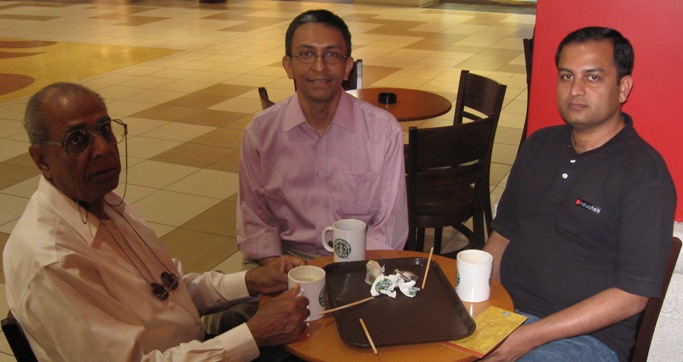
Photo shows (L to R) Rashid Latif, Nalaka Gunawardene and Sohail Khan in Dubai, May 2006

As Sohail Khan, Director Operations of Ujala TV, recalled recently: “I still cherish the excitement when I was at Samacom (the Uplink Earth Station at Dubai) at around 2 am Dubai Time to press the button to air Ujala for the very first time at 00:00 GMT on 2 July 2007 (4 am Dubai Time) to start the Test Transmission.”

They had worked long and hard to get to that point. A few weeks earlier, in mid May 2006, I stopped over in Dubai specifically to meet Rashid and his team who were busy preparing to launch. At that time, they were working out of their office for 16 – 18 hours a day, every day, and sleeping a few hours at the office itself.

This was no multi-million dollar start up channel. The entire operation was being financed by Rashid Latif from personal funds. Although the channel’s aims were entirely in the public interest, he declined to seek funding from development donors or philanthropic foundations.

A Pakistan-born Canadian citizen, Rashid worked in the Pakistan government as a senior broadcast manager before heading west to work in the corporate sector. He started Ujala TV after formal retirement.

“I started working on ‘Ujala’ project (at the age of 75) when most of my contemporaries had either played their innings or were about to pack up and leave for the pavilion,” Rashid said in a recent letter.

Until this letter, I had no idea that Rashid was 75. He has the energy and drive of someone in his late 50s or early 60s!

Sohail looks back on the first year: “During this first year, we came across many difficulties, including, changing laws in India and Pakistan for Landing Rights with huge financial requirements, and increase in running costs due to change in different rentals here in Dubai. These problems, however, do not have any effect on our determination, and we are still trying to eliminate the darkness from our part of the world, and to spread Ujala.

nalaka-with-rashid-latif.jpg

The new channel still struggles to establish its brand identity and distribution networks — it’s not easy to compete with big corporations with their deep pockets.

But a modest start has been made. Now we need to sustain the momentum.

Meanwhile, Rashid is looking for a dynamic South Asian national to take over from him, so that he can fully retire. Now that’s going to be a tall order.

Declaration of interests:
1. I am on the honorary Board of Governors of People’s Education Network along with over a dozen academics, journalists and film-makers who share Rashid’s ideal for a South Asian public interest TV channel.
2. TVE Asia Pacific has supplied many development films to Ujala TV over the past few months.

Read Aman Malik’s article in Himal Southasian on Channel Southasia

Pay-back time for film-makers: Go back to your locations!

“These days it’s simply not good enough to use the old response… “If people know about it they’ll care for it and do something”. Wrong. They’ll just go on being conned that it’s all perfect out there, with endless jungles, immaculate Masai Maras, and untouched oceans. What planet are they on about?”

These words come from Richard Brock, one of the world’s leading and most senior natural history film makers.

If you haven’t heard his name, chances are that you know at least some of his many creations: he worked in the BBC Natural History Unit producing, among others, the highly successful Life on Earth and Living Planet series presented by David Attenborough.

Image courtesy The Brock Initiative Image courtesy Brock Initiative

The BBC Natural History Unit (NHU) is a department of the BBC dedicated to making TV and radio programmes with a natural history or wildlife theme, especially nature documentaries. It celebrates 50 years in 2007.

Richard Brock worked with them for 35 of those 50 years. He left them a few years ago, according to his own website, ”concerned by the lack of willingness to address the real current state of the environment”.

He then started his own independent production company, Living Planet Productions, which has made over 100 films on a wide range of environmental topics, shown all over the world. As his archive of films and footage mounted up, Richard felt that there was something more, better, that could be done with this resource.

“We’ve been celebrating nature by bringing its wonders to the TV screen all over the world. Now that world is changing, faster and faster, and nature needs help. Films can do that, at a local level, be it with decision-makers in the government or in the village,” he says.

He adds: “When you consider the miles of footage and thousands of programs sitting in vaults out there unused, it seems tragic that the very wonders they celebrate are dwindling, often because no one tells the locals and tries to help. That is why I believe its Payback Time for the wildlife television.”

Thus the Brock Initiative was born. To quote from their website:
“He decided to set up the Brock Initiative, to use his archive of footage, and to ask others to do the same, to create new programs, not made for a general TV audience, but made for those who are really connected to the situation in hand: local communities, decision makers, even that one fisherman who uses dynamite fishing over that one coral reef. Its about reaching those who have a direct impact; reaching those who can make the difference.”

As he emphatically says: “Showing the truth on some minority channel is not the answer. Showing it where it counts, is.”

Image courtesy The Brock Initiative

I hope those development donors and corporate sponsors, who try to outdo each other in supporting programming going out on BBC World (an elite minority channel in most markets) hear people like Richard Brock — long-time BBC insiders who know what they are talking about.

Those who make documentaries on wildlife, natural history or environment (and wild-life of humans) are trapped in their industry’s many contradictions. They go on location filming to the far corners of the planet, capturing ecosystems, species and natural phenomena. Yet for a long time, many have avoided talking about or featuring the one species that has the biggest impact on Nature: Homo sapiens (that’s us!).

Whole series of wildlife documentaries have been made, by leading broadcasters and production houses of the east and west, without once showing a human being or human activity in them. Almost as if humans would ‘contaminate’ pristine Nature!

In recent years, more film-makers have broken ranks and started acknowledging the human footprint on the planet and its environment. But a good many documentaries are still made with ‘pure’ wildlife content, with not a thought spared on the wild-life of our species.

Richard Brock is one who has refused to follow the flock. And he has also punctured the highly inflated claims — promoted by BBC Worlds of this planet — that broadcast television can fix the world’s problems.

As we have found out here in Asia, it’s a judicious combination of broadcast and narrowcast that can work – and we still need the participation of teachers, activists and trainers to get people to think and act differently.

At their best, broadcasts can only flag an issue or concern to a large number of people. For attitudes and behaviour to change, that needs to be followed up by narrowcast engagement at small group levels.

Taking films to the grassroots need not be expensive, says Brock. In fact it can be done inexpensively.

These are not programmes for broadcast to western audiences demanding BIG productions – you are often showing films to people who have never even seen TV. The effort comes in showing the right thing, to the right people, in the right way, and not about expensive effects, top quality cameras or cutting edge effects.”

Using donated archive footage cuts costs dramatically. New footage, important for putting a film in a local context, can be taken on small miniDV cameras and editing can be done on any home computer. In this way, it becomes feasible to put together a film even for a very small, but crucial audience.

The Brock Initiative, started and funded by donations from its founder, has projects in Kenya, Madagascar, Tanzania, the UK and Indonesia.

Read more about the Indonesia project

They also offer wildlife and nature footage free to those who want to use moving images to make a difference.

Read Richard Brock’s formula for making films that make a difference!

As our species’ wild-life pushes our living planet closer to peril, we need many more Richard Brocks to try and reverse disturbing trends at the edges of survival — almost all of them in the global South.

It’s pay-back time, film-makers!

Related blog posts:
End this callous waste – open up broadcast archives for combating poverty and ignorance

Lawyers who locked up the butterfly tree

Anita Roddick, Angkor Wat and the Development Pill

Contact The Brock Initiative

Playing Shahrazad; Telling Stories to Save Ourselves…and the Planet

I’ve been silent on this blog for over 20 days. I like to think that was for a good cause.

Well, I was frightfully busy organising and running a small Asian regional workshop in Khao Lak, Thailand – it was part of TVE Asia Pacific’s Saving the Planet project.

Saving the Planet is telling real life stories to save our planet in peril. It was inspired by the Arabian Nights.

Remember how the clever and beautiful Shahrazad saved herself and other women in her kingdom from the murderous King Shahriyar? Once betrayed by a wife, the wicked ruler had embarked on a killing spree where he would wed a virgin bride everyday, and have her beheaded the day after the wedding. All girls and women in his kingdom were threatened.

That is, until, beautiful and clever Sharrazard volunteered to be the next bride. Facing an assured death, she starts telling the king engaging stories that holds him spell-bound. Her story, or stories, since many tales are interwoven and imbedded into the first, lasts for 1001 consecutive nights.

This story-telling captivated the king’s attention and held his patience with its fantastic and mysterious tales, its vivid descriptions and breath-taking heroism. Shahrazad’s story-telling is in itself a heroic and life-saving device, which finally forced the king to spare the wise and courageous girl’s life. Apparently he gave up his killing ways after that experience (if only some of our modern day rulers were so easily reformed!).

Image courtesy Rose TheatreImage courtesy Middleeast UK.comImage courtesy Middleeastuk.com

Read more about Arabian Nights

Story telling is more an art than a science. Shahrazad used it to save her life, and lives of all other women in her kingdom. Mythical as it may be, we can draw a few lessons from the Arabian Nights on what kind of stories to tell — with visible effects.

Good journalism is all about telling stories — real life stories about what happens to real world men, women and children. Mixing journalistic skills with development stories as we do, Saving the Planet is an attempt to tell a few good stories from the Asia Pacific — about individuals and organisations who are engaged in education for sustainable development, or ESD.

As we introduce the project on its dedicated website:
Confronted with a range of environment and development problems, the world is looking for bright ideas to sustain life on the planet. Education at all levels can shape the world of tomorrow, equipping individuals and societies with the skills, perspectives, knowledge and values to live and work in a sustainable manner. Education for Sustainable Development (ESD) is a vision of education that seeks to balance human and economic well-being with cultural traditions and respect for the earth’s natural resources.

copy-of-saving-the-planet-logo.jpg dd8.gif

Saving the Planet started with an open competition – we asked people to nominate projects or activities in developing countries of Asia that are communicating or educating their communities on any aspect of sustainable development. Not just ‘green’ issues (e.g. recycling, conservation) or scarey issues like climate change and ozone depletion, but also ‘brown’ issues (e.g. sanitation, cleaner production) and what I call ‘black and white issues’ – human rights and social justice.

We received dozens of nominations, which we turned over to a regional selection panel. Their final selection was announced in mid May 2007 – see my blog post on the winners.

Read more about the winning stories on Saving the Planet website

The idea is for us to go out and film each of these winning projects for an Asian regional TV series. But ahead of that, we brought to Khao Lak, Thailand, two representatives of each project/organisation for a week-long workshop, 2 to 6 July 2007.

That workshop sought to strengthen the communication skills and capacity of the six organisations. Not just in moving images, which we dabble in, but in new media and older media as well. In short, how to use media and other communication tools to reach out to different audiences and, hopefully, influence them in positive ways that help them — and the planet.

This is why Saving the Planet is also story telling for survival – and here we are talking about the survival of not just one individual, but of all life on the planet. And instead of one evil king, our story tellers are confronted with a multitude of threats to our survival, many of them of our own making.

The analogy with the Arabian Nights is not as far-fetched as it might seem. The success of the Arabian Nights stories over many other forgotten folk tales may be due to their blend of popular themes: heroic and romantic adventures are littered with mystery, old wisdom and exciting struggles between good and evil. Almost all tales have three main elements or notions. Firstly, if there is a problem, there is a solution. Secondly, endurance can enable a crisis to reach a resolution. And finally, fantastic elements help the protagonists to maintain their endurance.

So one thing we kept probing and discussing was how to package serious (and often perceived as ‘boring’) development messages in ways that engage and entertain groups or communities we are trying to reach.

I’ll write more about the workshop when I have a chance. The official report of the workshop will go up on TVEAP and Saving the Planet websites within a few weeks.

For now, here’s the photo of our participants, together with the resource team and my colleagues from TVE Asia Pacific.

participants-and-resource-team-of-saving-the-planet-workshop-in-khao-lak-july-2007.jpg

Saving the Planet is implemented by TVE Asia Pacific in collaboration with the Asia/Pacific Cultural Centre for UNESCO (ACCU),Tokyo, Japan, within the framework of ACCU-UNESCO Asia-Pacific Programme under the UNESCO/Japan Funds-in-Trust for the Promotion of Education for Sustainable Development.